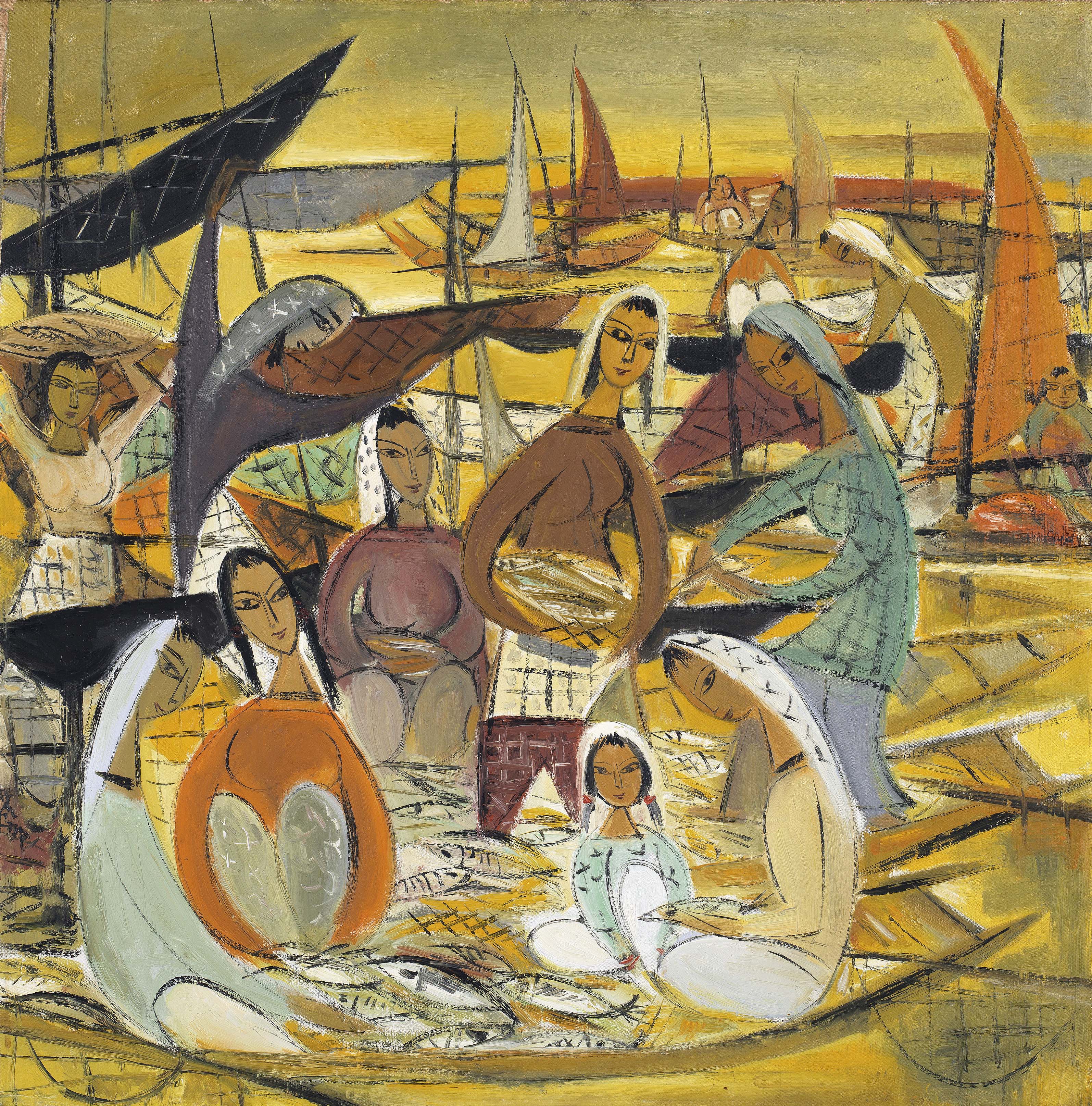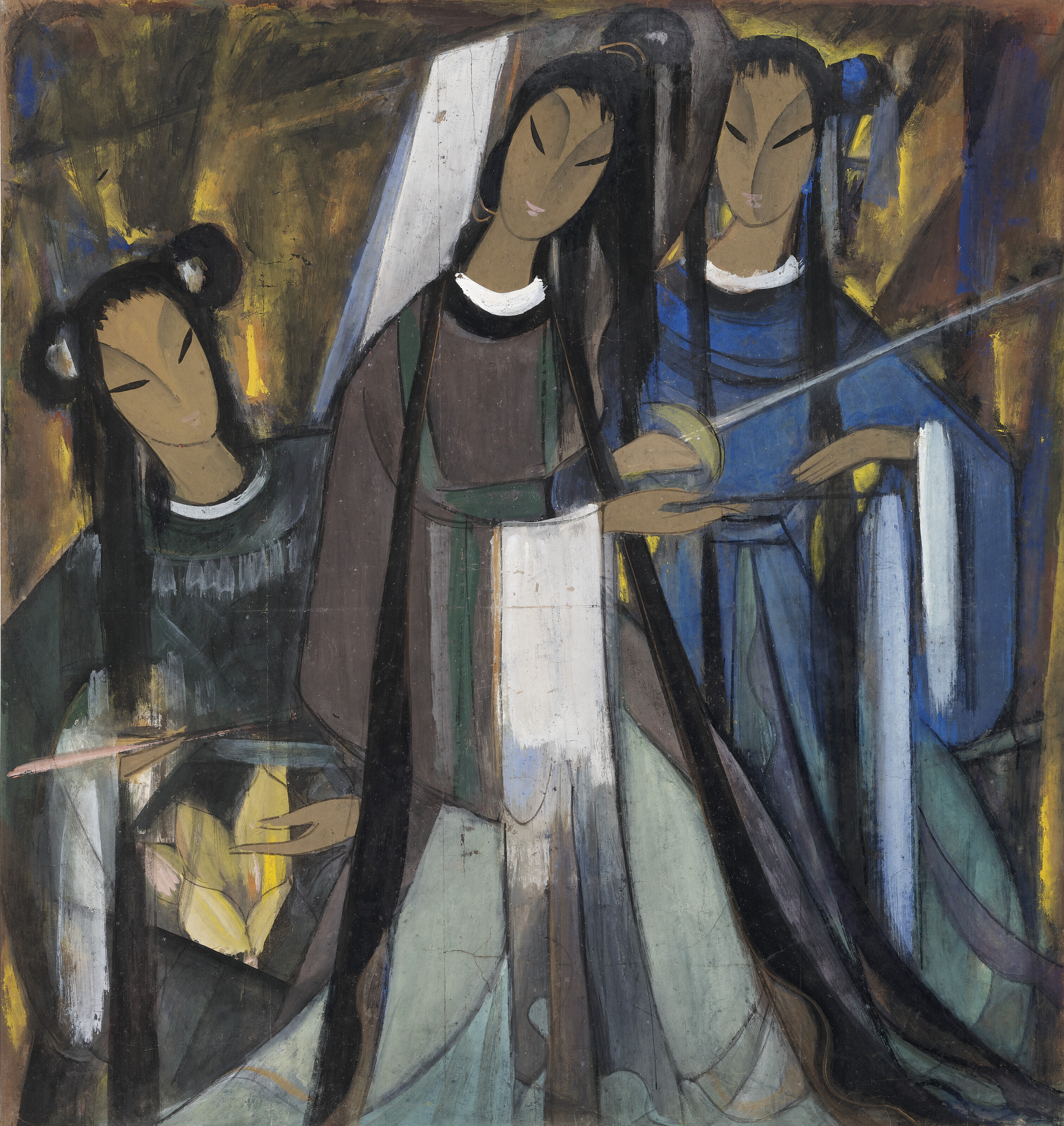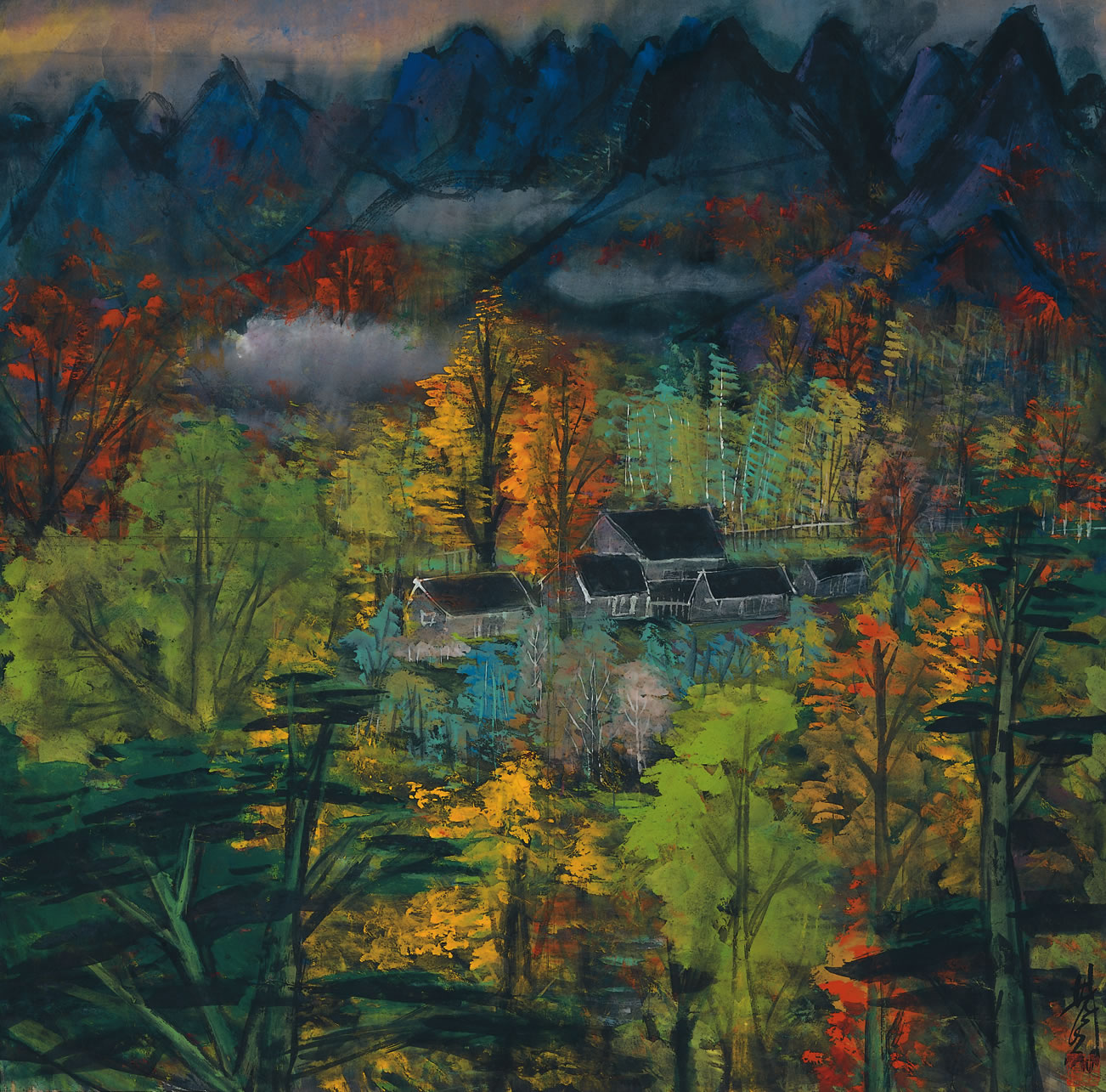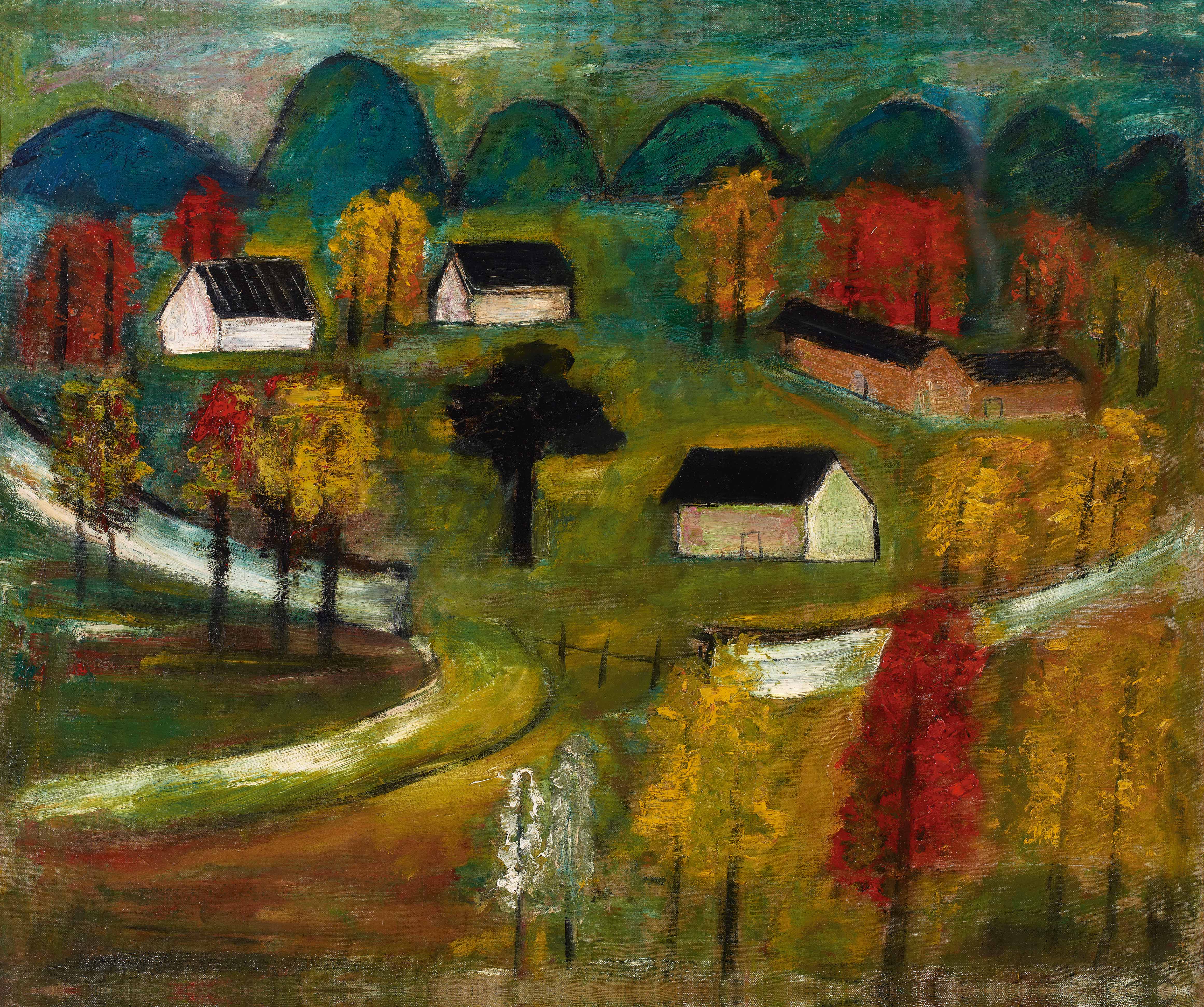
Lin's synthesis was never a decorative mixture: it was a way to rebuild pictorial form after personal grief, war, institutional conflict, and political violence.
1900-1919
A stonecarver's village, early painting, and lasting loss
Lin Fengmian was born in Gegongling Village in Meixian, Guangdong, into a Hakka family of stonecarvers. His grandfather carved gravestones, and his father wrote their inscriptions, painted, and introduced the boy to the Mustard Seed Garden Manual. Lin's mother was sold away from the family when he was seven, a separation that remained one of the deepest wounds of his life. He painted from childhood, but his departure for Europe emerged from the wider work-study movement that linked education to national renewal after the fall of the Qing dynasty. In 1919 he raised funds in Shanghai and sailed for France in a fourth-class berth with other young Chinese students.1919-1925
Dijon, Paris, Berlin, and the discovery of expressive modernism
Lin reached Marseille in January 1920, learned French while working, and entered the Ecole des Beaux-Arts in Dijon. Its director recognized his ability and recommended him to Fernand Cormon's studio at the Paris Beaux-Arts. Academic training gave Lin command of drawing, but museums, salons, and travel made a more decisive impact. He absorbed Impressionism, Fauvism, post-Impressionism, and German expressionist intensity during a year in Berlin. His paintings appeared in the Salon d'Automne, and forty-two works entered the 1924 Strasbourg exhibition of Chinese art. That year his first wife, Elise von Roda, died shortly after childbirth, and their infant son soon followed. Personal grief, exposure to modernist form, and the problem of cultural renewal converged before his return to China.1926-1937
Beijing controversy and the founding of Hangzhou's modern academy
Back in China, Lin became director of the National Beijing Fine Art School in 1926. He expanded music and drama, hired Qi Baishi despite opposition, introduced nude drawing, and organized a major Beijing Art Assembly. Conservative and political resistance removed him from office in 1927. Supported by the educational reformer Cai Yuanpei, Lin then founded the National Academy of Art in Hangzhou in 1928 and served as its first president. The school placed Chinese and Western painting, design, music, and modern pedagogy together under a principle of academic openness. Its students included Zao Wou-Ki, Chu Teh-Chun, Wu Guanzhong, Li Keran, and many artists who would define several different modernisms. Lin's achievement was institutional as much as stylistic: he made comparison part of everyday artistic training.1937-1952
War, resignation, Chongqing solitude, and the move to Shanghai
After Japanese invasion in 1937, Lin led more than two hundred academy teachers and students out of Hangzhou with books and teaching materials. The school merged with the Beiping college, but administrative conflict forced his resignation in 1938. His home was ransacked and paintings destroyed. Lin moved through Shanghai and Hong Kong before reaching wartime Chongqing in disguise, where he lived simply and painted for years. He briefly returned to teaching after the war but was repeatedly dismissed and reinstated as political systems changed. In 1951 he left the academy and settled in Shanghai. There, in a semi-reclusive life supported by small sales and occasional students, he concentrated on painting and discovered in Chinese opera a visual language of compressed time, layered action, angular costume, and shadow-puppet silhouette.1952-1977
The square format, precarious survival, destruction, and prison
In Shanghai Lin developed the square compositions now most closely associated with him. Landscapes, women, flowers, birds, and opera figures combine translucent ink, opaque color, backlighting, folk forms, and modernist geometry. The square rejected both the conventional hanging scroll and a window-like European perspective, creating a concentrated field where several spatial systems could coexist. Political campaigns repeatedly narrowed his life. He was sent to labor in 1958 and criticized for an Impressionist publication. During the Cultural Revolution he soaked and pulped many paintings to prevent them from being used as evidence against friends. Arrested in 1968 on fabricated espionage charges, he endured torture and four years in detention. Released at the end of 1972, he resumed work under continuing surveillance and criticism.1977-1991 and after