Modern Chinese ArtistsObject Study 05

Lin Fengmian / 林风眠

Lotus Lantern

1956

Opera compresses time into overlapping masks and robes

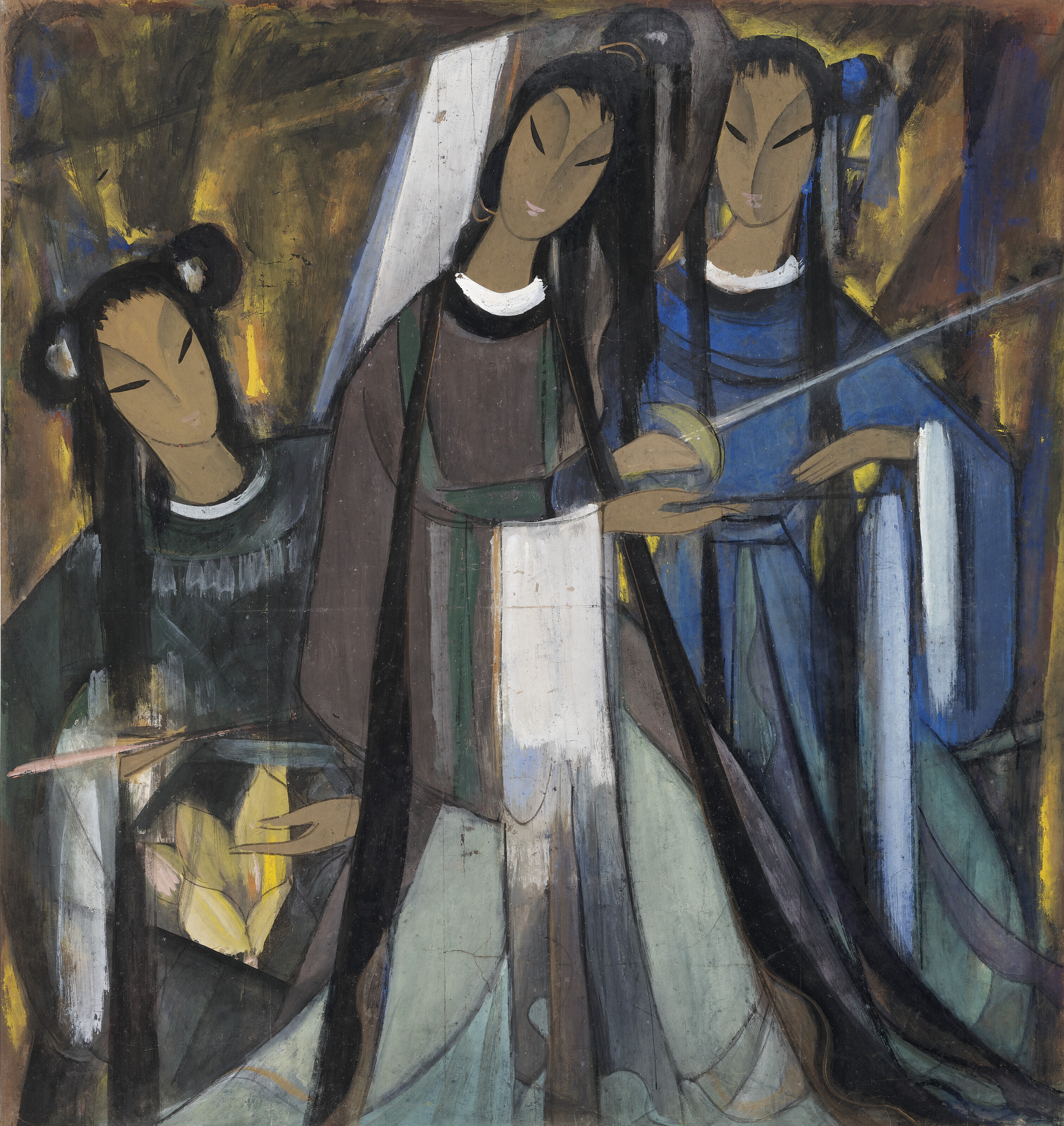
Lin Fengmian's Lotus Lantern, an ink-and-color image of geometric Chinese opera figures
Image reference: Sotheby's catalogue. Educational presentation.
Lotus Lantern100%
Lin Fengmian's Lotus Lantern, an ink-and-color image of geometric Chinese opera figures

Use the controls or mouse wheel to zoom. Drag the image when enlarged.

Enter the artwork study
04

Object in the Lin Fengmian study

Date
1956
Medium
Ink and colour on paper
Dimensions
68.9 x 67.3 cm
Collection / record
Private collection; documented by Sotheby's
Catalogue / accession
Hong Kong 2021, lot 1014

01 / Why this work matters

Opera compresses time into overlapping masks and robes

Lin was fascinated by how opera allows successive actions and identities to occupy one stage. In Lotus Lantern, figures overlap within a square field, their costumes broken into angular planes and sweeping curves. Narrative remains present, but time is compressed into a simultaneous visual event.

Cubist layering is one resource among several. Paper-cut silhouettes, shadow puppetry, painted opera masks, and calligraphic line are equally important. Lin's synthesis is convincing because these sources share a concern with contour, transformation, and staged movement rather than merely resembling one another.

02 / Formal analysis

Five ways to read the visible evidence.

Move from color and composition toward the material surface and the space the work asks you to inhabit.
01

Color and light

Red, black, gold, and blue establishing dramatic contrast

02

Composition and rhythm

Faces functioning as masks inside larger geometric bodies

03

Line and gesture

Robes moving between straight architecture and fluid line

04

Surface and material

Cubist layering is one resource among several. Paper-cut silhouettes, shadow puppetry, painted opera masks, and calligraphic line are equally important. Lin's synthesis is convincing because these sources share a concern with contour, transformation, and staged movement rather than merely resembling one another.
05

Space and scale

Lin was fascinated by how opera allows successive actions and identities to occupy one stage. In Lotus Lantern, figures overlap within a square field, their costumes broken into angular planes and sweeping curves. Narrative remains present, but time is compressed into a simultaneous visual event.

03 / History and object record

Place the image inside a life, a period, and a documented record.

Historical interpretation

Lin Fengmian, 1956

Cubist layering is one resource among several. Paper-cut silhouettes, shadow puppetry, painted opera masks, and calligraphic line are equally important. Lin's synthesis is convincing because these sources share a concern with contour, transformation, and staged movement rather than merely resembling one another.

The painter and educator who made the square sheet a meeting place for color, ink, opera, folk form, and European modernism.

Exhibition and record history

What the cited record establishes

Recorded collection
Private collection; documented by Sotheby's
Catalogue reference
Hong Kong 2021, lot 1014
Exhibition chronology
The cited public record does not provide a complete exhibition chronology. Follow the primary record for provenance, display history, and future updates.

04 / Connections

Continue through neighboring works and parallel modernisms.

05 / Sources and further reading

Follow the object back to its institutional record.