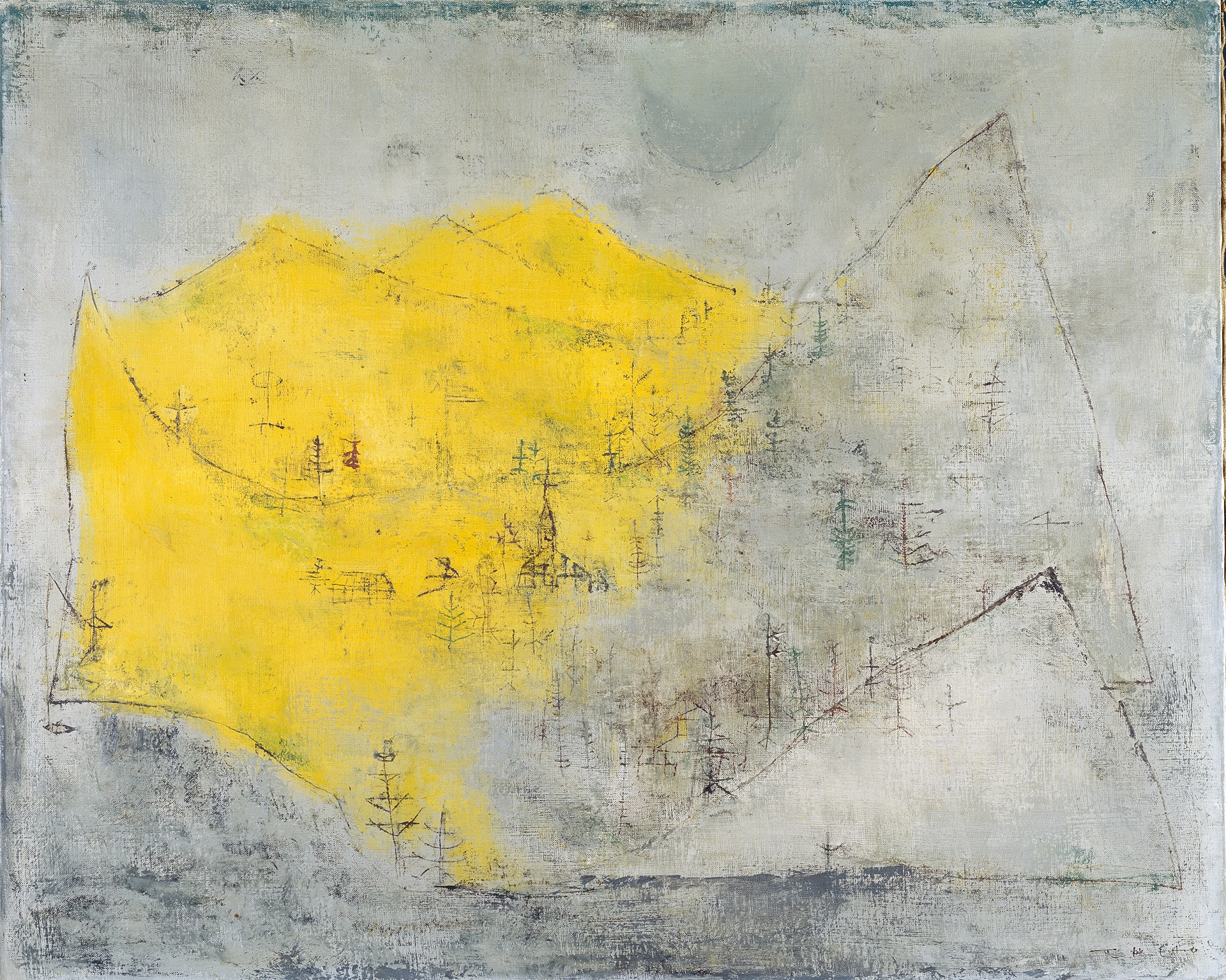
Montagne grise et jaune by Zao Wou-Ki, a yellow mountain landscape traced with fine signs on a grey field

Zao Wou-Ki / 赵无极

Zao Wou-Ki

The painter who turned landscape, calligraphy, memory, and postwar abstraction into an atmosphere you can enter.

Begin the life story
01

Montagne grise et jaune1950

1920-2013Beijing / Hangzhou / ParisOil / Ink / Watercolor / PrintPostwar lyrical abstraction

01 / Biography

A life across schools, wars, cities, and pictorial languages.

Zao Wou-Ki did not combine two sealed traditions. He built a modern language inside a moving network of Chinese education, wartime displacement, Parisian friendships, American scale, poetry, music, grief, and return.

Zao made paintings that feel like weather systems: light gathers, matter fractures, signs hover, and vast spaces open without becoming empty.

1920-1948

Family, calligraphy, and the Hangzhou academy

Zao Wou-Ki was born in Beijing in February 1920 and grew up in an educated banking family in Nantong, north of Shanghai. His grandfather introduced him to the disciplined formation of Chinese characters, while family access to books and reproductions made painting feel like a serious intellectual pursuit. At fifteen he entered the Hangzhou School of Fine Arts, a modern academy where Chinese and European approaches were taught together. When the Sino-Japanese War forced the school inland to Chongqing in 1938, artistic education continued under displacement. Zao graduated in 1941, became an assistant teacher, and held his first solo exhibition. Reproductions of Cézanne, Matisse, and Picasso gave him a distant but powerful model of modern art. By 1946, twenty of his works had already been shown at the Cernuschi Museum in Paris.

1948-1956

Paris and the escape from subject matter

In February 1948 Zao left Shanghai with his first wife, the artist and composer Lalan. After thirty-six days at sea they reached Marseille and then Paris. He visited the Louvre, studied French, attended the Académie de la Grande Chaumière, and worked in Montparnasse near Alberto Giacometti. A first Paris exhibition followed in 1949, alongside an expanding practice in lithography. The poet Henri Michaux became a close friend and helped connect him with gallerist Pierre Loeb. During a 1951 visit to Switzerland, Zao encountered Paul Klee's symbolic paintings and found a way beyond direct representation. Still lifes and landscapes gave way to invented signs, imagined writing, and fields of atmosphere. Vent, painted in 1954, is often identified as the moment when the depicted subject almost entirely disappeared.

1957-1969

Large scale, New York, and an international language

Zao's first exhibition at Galerie de France in 1957 coincided with a decisive enlargement of his canvases. Later that year he traveled to New York, where he met artists including Franz Kline, Philip Guston, Adolph Gottlieb, and William Baziotes. He admired the physical immediacy of American painting, but his own work did not simply become Abstract Expressionist. Its open space, suspended marks, and shifting voids remained connected to Chinese landscape and calligraphic structure. The Kootz Gallery gave him annual New York exhibitions from 1959 to 1965, while museums in Europe, North America, and Japan began to collect and show his work. With support from André Malraux, Zao became a French citizen in 1964. The large dated paintings of the decade established his mature language: pressure, light, and movement without a fixed horizon.

1970-1985

Loss, ink, and renewed contact with China

In 1971, encouraged by Michaux, Zao returned seriously to Chinese ink, a medium whose unforgiving speed demanded a different balance of control and accident. The following year his second wife, May, died after a long illness. Zao traveled to China for the first time since 1948, then slowly resumed painting in Paris. En mémoire de May transformed private grief into a monumental field more than five meters wide. During the later 1970s he made increasingly large canvases and triptychs, while Pierre Matisse renewed his connection to New York. He taught mural painting in Paris from 1980 and received a major Grand Palais exhibition in 1981-82. Visits to China followed, including exhibitions in Beijing and Hangzhou in 1983 and a month of teaching at his former academy in 1985.

1986-2013

Late freedom, recognition, and legacy

Zao's later decades combined institutional recognition with experiments across oil, ink, watercolor, printmaking, ceramics, tapestry, and stained glass. A ten-meter triptych commissioned for I. M. Pei's Raffles City complex demonstrated how fully he could command architectural scale. Retrospectives traveled through Europe, Asia, and the Americas; he received Japan's Praemium Imperiale for painting in 1994 and was elected to the French Académie des Beaux-Arts in 2002. Yet the late oils often feel lighter rather than more official, opening into vivid color and renewed hints of plants, boats, and landscape. Zao stopped painting in oils in 2008 and made his final watercolors in 2010. He died in Nyon, Switzerland, on April 9, 2013. The Foundation records his work in more than 150 public collections across twenty countries.

02 / Selected works

Ten paintings, read one at a time.

Each chapter follows a distinct problem in Zao's career: how a subject dissolves, how writing becomes energy, how scale surrounds the body, and how color carries memory.

Montagne grise et jaune by Zao Wou-Ki, a yellow mountain landscape traced with fine signs on a grey field
Artwork image courtesy Fondation Zao Wou-Ki. © Zao Wou-Ki - ProLitteris, Zurich.

01 / 1950

Montagne grise et jaune

A landscape begins to loosen

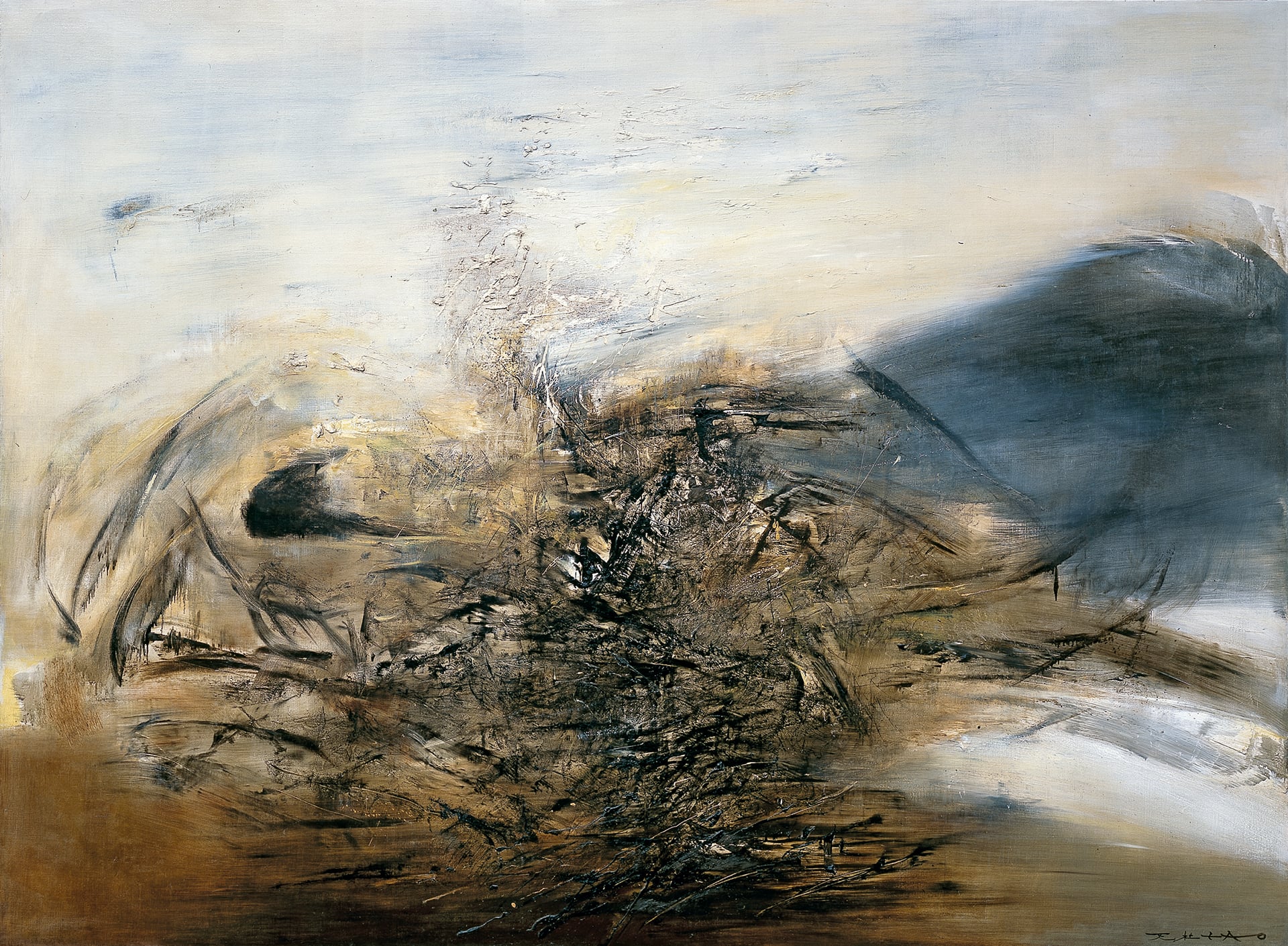
Made only two years after Zao arrived in Paris, this painting still names a recognizable subject. A yellow mountain occupies the surface, but it is less a solid object than a zone of color suspended inside a cool grey field. Fine, wiry marks describe villages, trees, paths, and structures without settling into conventional perspective.

The work belongs to Zao's early search for a modern pictorial language. European modernism helped him flatten and simplify the scene, while the economy of Chinese painting kept empty space active. The landscape is already becoming a memory system rather than a report of a place.

Look closely

  • The yellow mass acting as both mountain and pure color
  • Tiny signs that hover between objects and writing
  • Grey space that feels atmospheric rather than empty
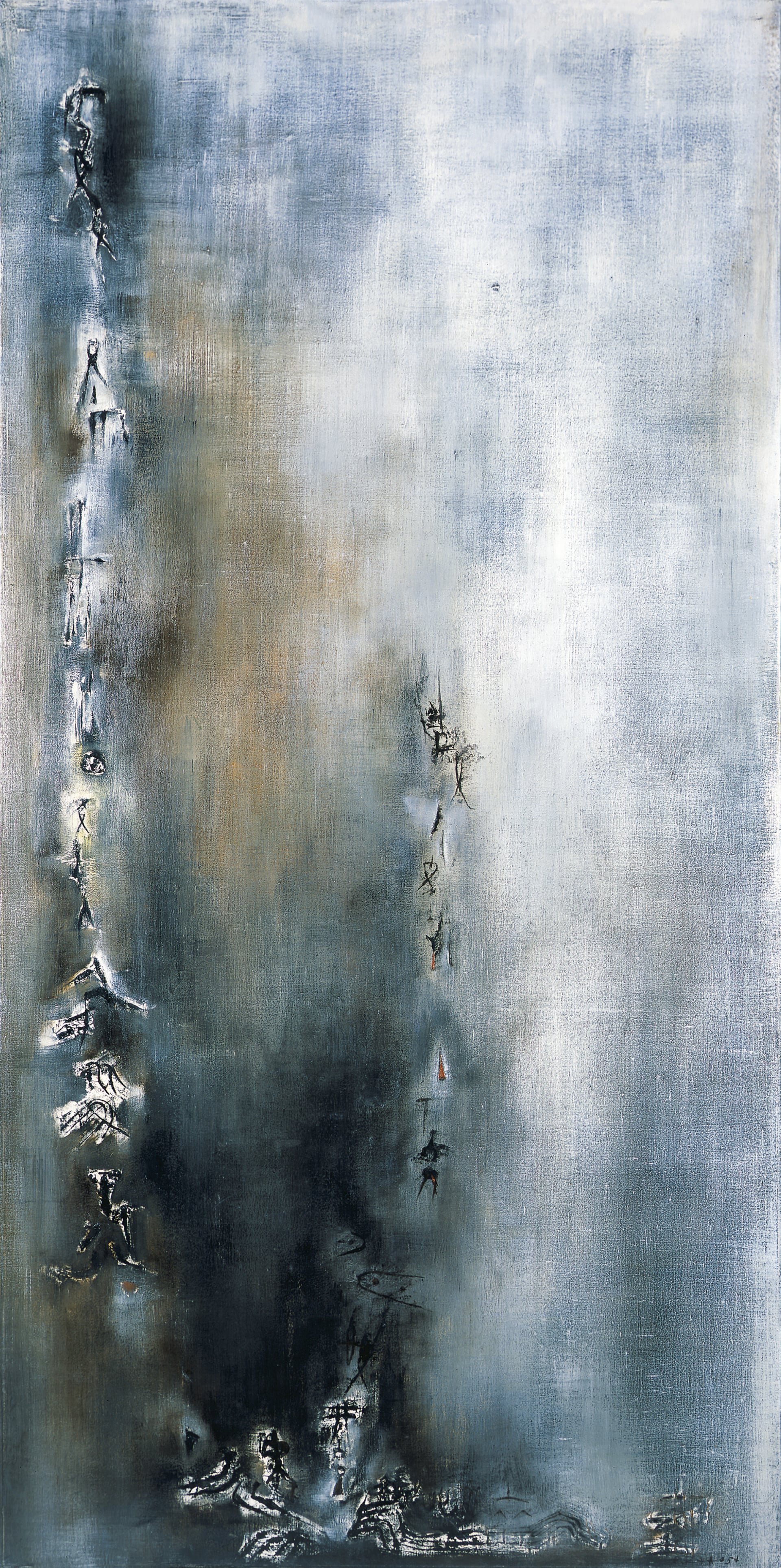
Vent by Zao Wou-Ki, a tall grey and black composition crossed by a cascade of invented signs
Artwork image courtesy Fondation Zao Wou-Ki. © Zao Wou-Ki - ProLitteris, Zurich.

02 / 1954

Vent

The subject disappears

Vent is often treated as Zao's first fully abstract painting. Its tall, narrow format is crossed by a descending current of marks, yet those marks do not spell a sentence or describe a scene. They make an invisible force - wind - perceptible through rhythm, interruption, and pressure.

Paul Klee had shown Zao how signs could operate without literal explanation. Here Zao pushed that discovery toward his own invented script. The dark column carries memories of calligraphy and ancient inscriptions, but meaning has moved from language into movement.

Look closely

  • The downward drift of marks through the vertical canvas
  • Edges that dissolve into smoky grey
  • A sense of motion produced without a depicted object
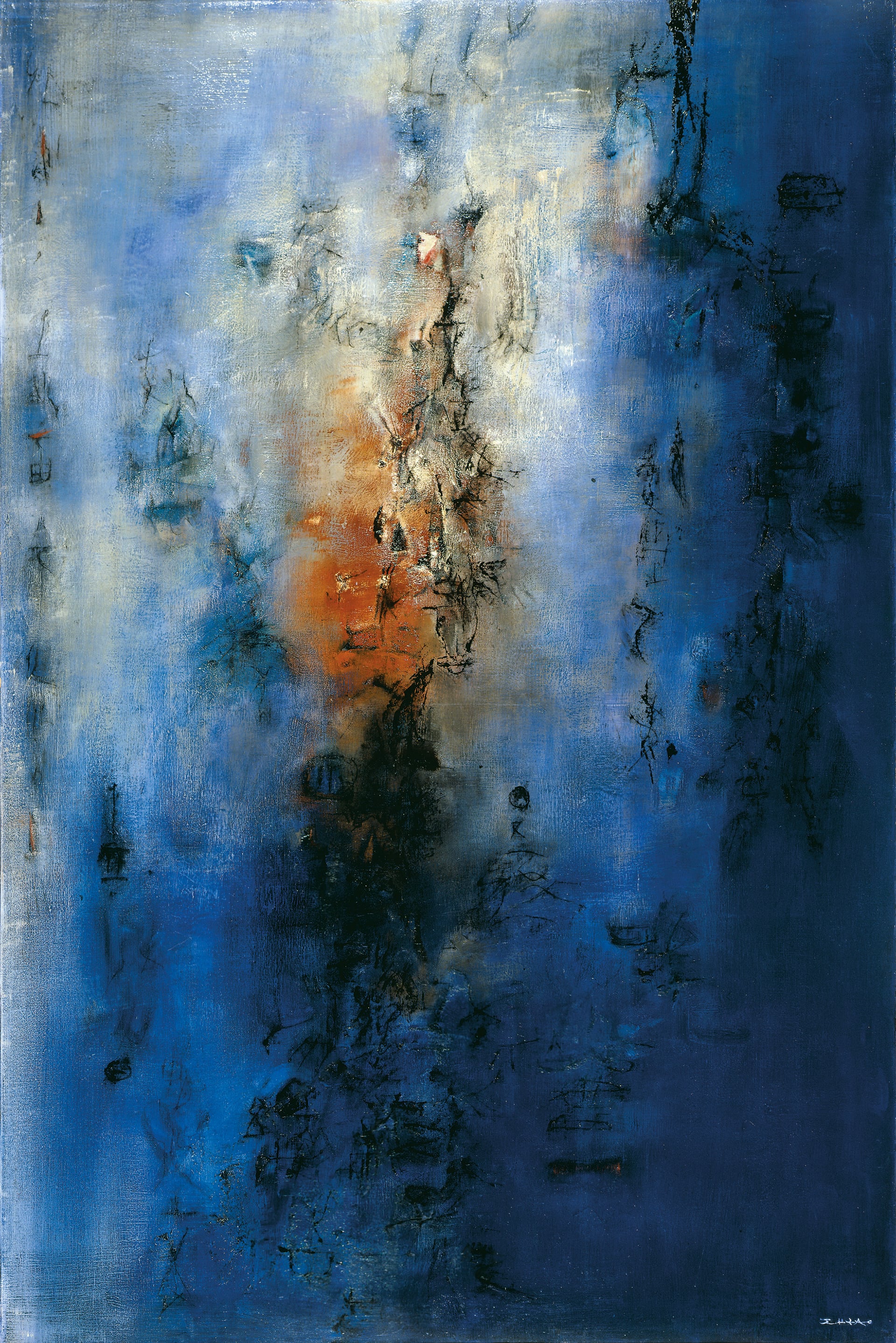
Hommage a Chu-Yun by Zao Wou-Ki, a blue vertical field with a dark center and scattered calligraphic signs
Artwork image courtesy Fondation Zao Wou-Ki. © Zao Wou-Ki - ProLitteris, Zurich.

03 / 1955

Hommage à Chu-Yun - 05.05.55

Memory becomes an invented script

The title honors Qu Yuan, the ancient poet whose death was remembered in a family ritual from Zao's childhood. Instead of illustrating the poet's story, Zao built a submerged blue space in which signs rise, fall, and gather around a dark vertical current.

The painting shows how cultural memory could survive inside abstraction without becoming a quotation of tradition. The forms resemble writing but refuse to be read. Their meaning is carried by spacing, density, and the sensation of watery depth.

Look closely

  • The dark channel that anchors the composition
  • Marks that feel ancient but cannot be translated
  • Blue shifting between air, water, and distance
Aube by Zao Wou-Ki, a monumental blue, ochre, and black abstract field filled with floating signs
Artwork image courtesy Fondation Zao Wou-Ki. © Zao Wou-Ki - ProLitteris, Zurich.

04 / 1957

Aube (aucun soir ni aucun matin)

The canvas becomes an environment

Aube was among Zao's first paintings on a truly monumental scale. Its title suggests dawn while refusing a specific horizon. Pale light opens through blue-grey atmosphere as dense black and rust-colored structures accumulate across the lower field.

The painting was completed before Zao's first trip to the United States, so its scale cannot simply be explained as a response to Abstract Expressionism. It shows that he was already searching for a painting large enough to surround the viewer and make space itself the subject.

Look closely

  • Light arriving from within the painted field
  • A low band of compressed energy under open atmosphere
  • Signs dissolving as the image moves toward full abstraction
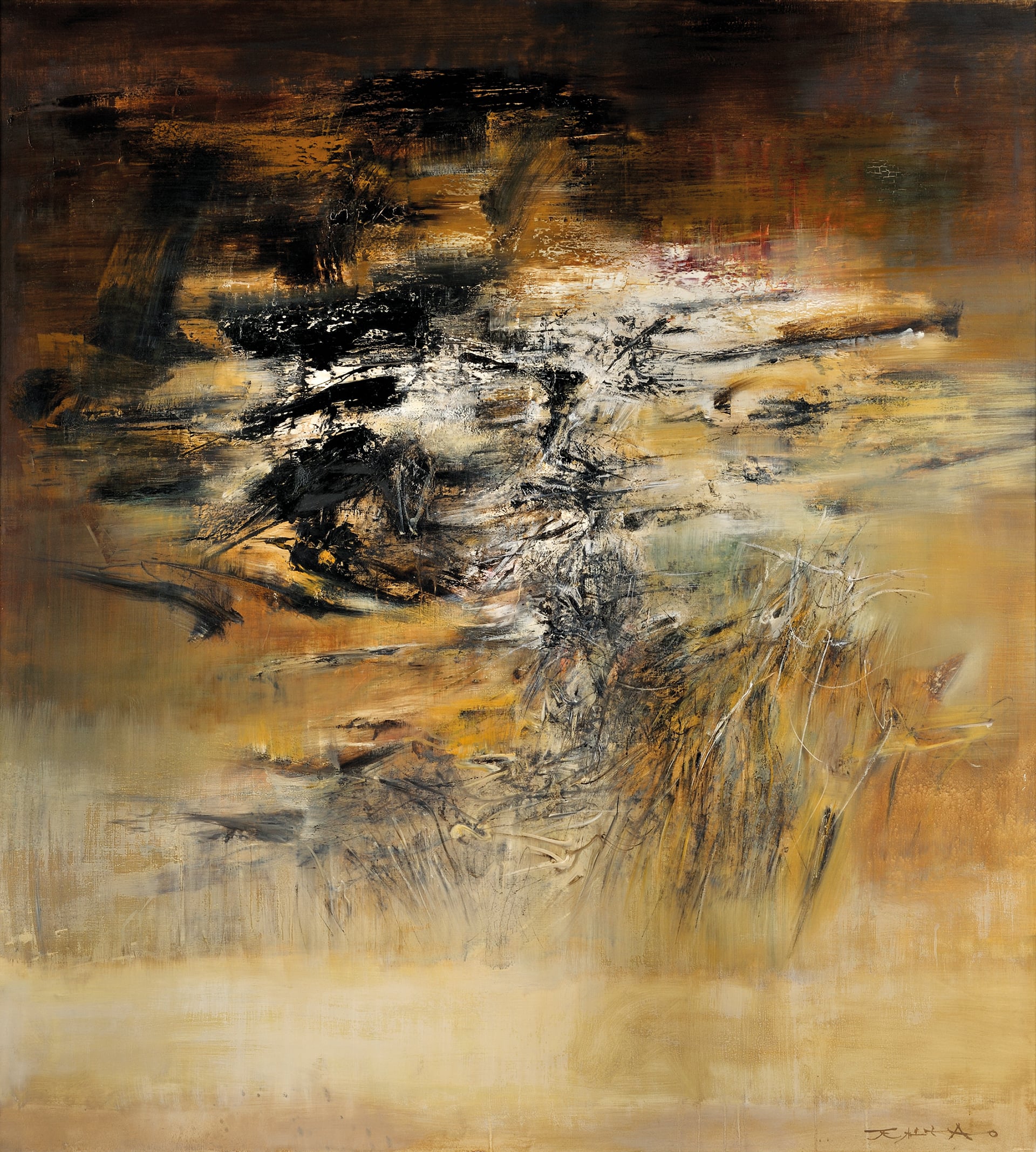
15.12.61 by Zao Wou-Ki, a vertical ochre and black abstract painting organized around a white burst
Artwork image courtesy Fondation Zao Wou-Ki. © Zao Wou-Ki - ProLitteris, Zurich.

05 / 1961

15.12.61

A date replaces the subject

By the early 1960s, Zao often titled paintings with the date on which they were completed. The neutral title blocks narrative instructions and asks the viewer to enter through the painting's internal weather. Here ochre, black, and chalky white compress into a turbulent vertical field.

The composition has no fixed foreground or background. Marks can read as fracture, spray, calligraphy, or geological pressure. That instability is central to Zao's mature language: the painting stays rooted in nature without turning into a picture of nature.

Look closely

  • A bright rupture around the center
  • Black masses that seem to advance and recede
  • The absence of a single stable horizon
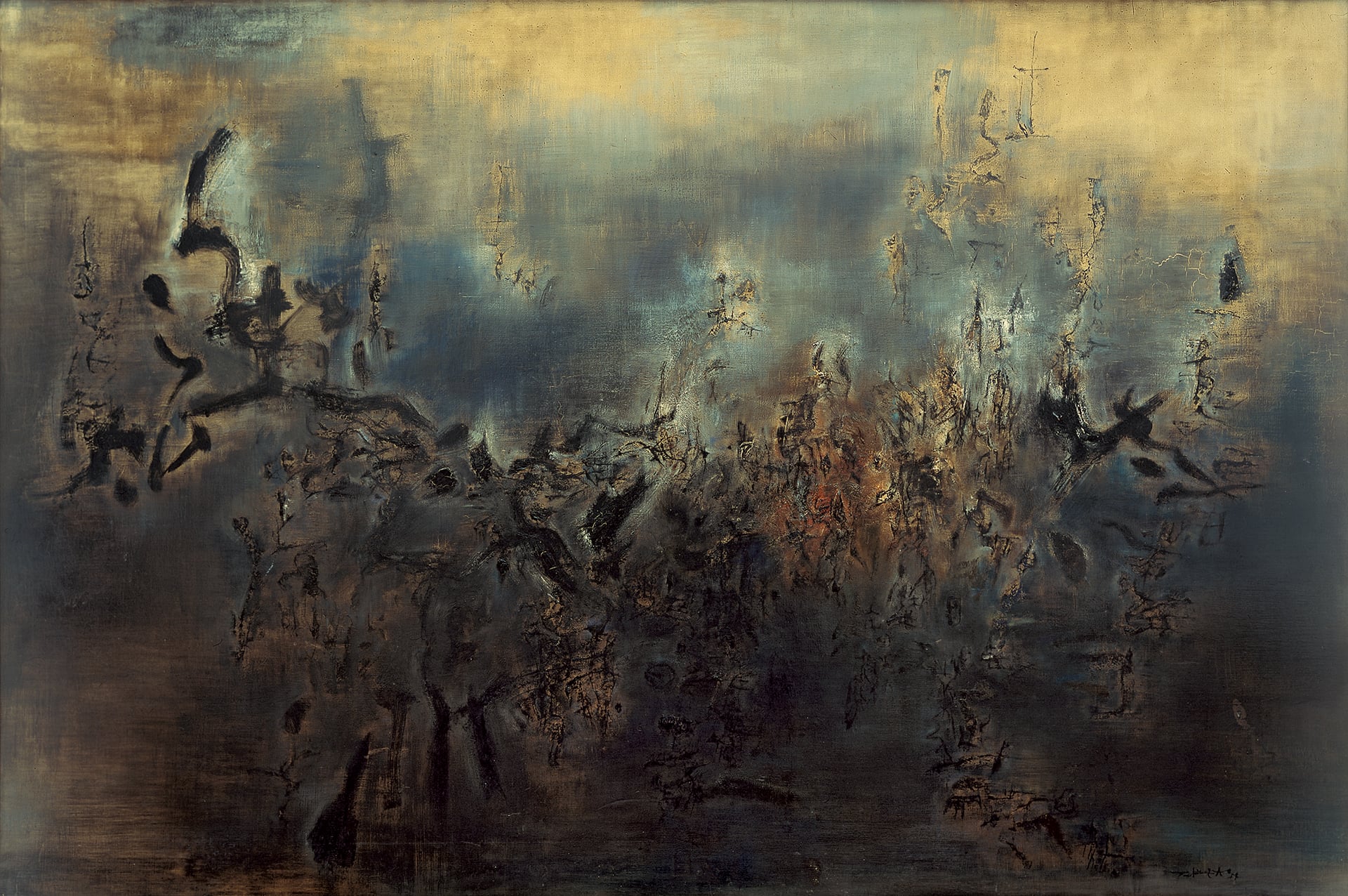
Hommage a Edgar Varese by Zao Wou-Ki, a sweeping black, ochre, white, and grey abstract composition
Artwork image courtesy Fondation Zao Wou-Ki. © Zao Wou-Ki - ProLitteris, Zurich.

06 / 1964

Hommage à Edgar Varèse - 25.10.64

Painting listens to music

Zao met the composer Edgar Varèse in 1954 while Varèse was working on Déserts. A decade later, this vast homage translated their shared interest in dynamic space into paint. Dense black structures collide with pale openings and long sweeps of ochre.

The painting does not illustrate a score. Instead, it uses contrast, interval, and silence as compositional forces. Empty passages expand around concentrated bursts, creating the visual equivalent of sound that gathers, breaks, and returns.

Look closely

  • Massed forms that behave like sound clusters
  • Pale intervals functioning like silence
  • Diagonal movement that keeps the field in tension
12.08.69 by Zao Wou-Ki, a wide painting of rust, black, cream, and white gestural fields
Artwork image courtesy Fondation Zao Wou-Ki. © Zao Wou-Ki - ProLitteris, Zurich.

07 / 1969

12.08.69

Gesture stretches across a horizon

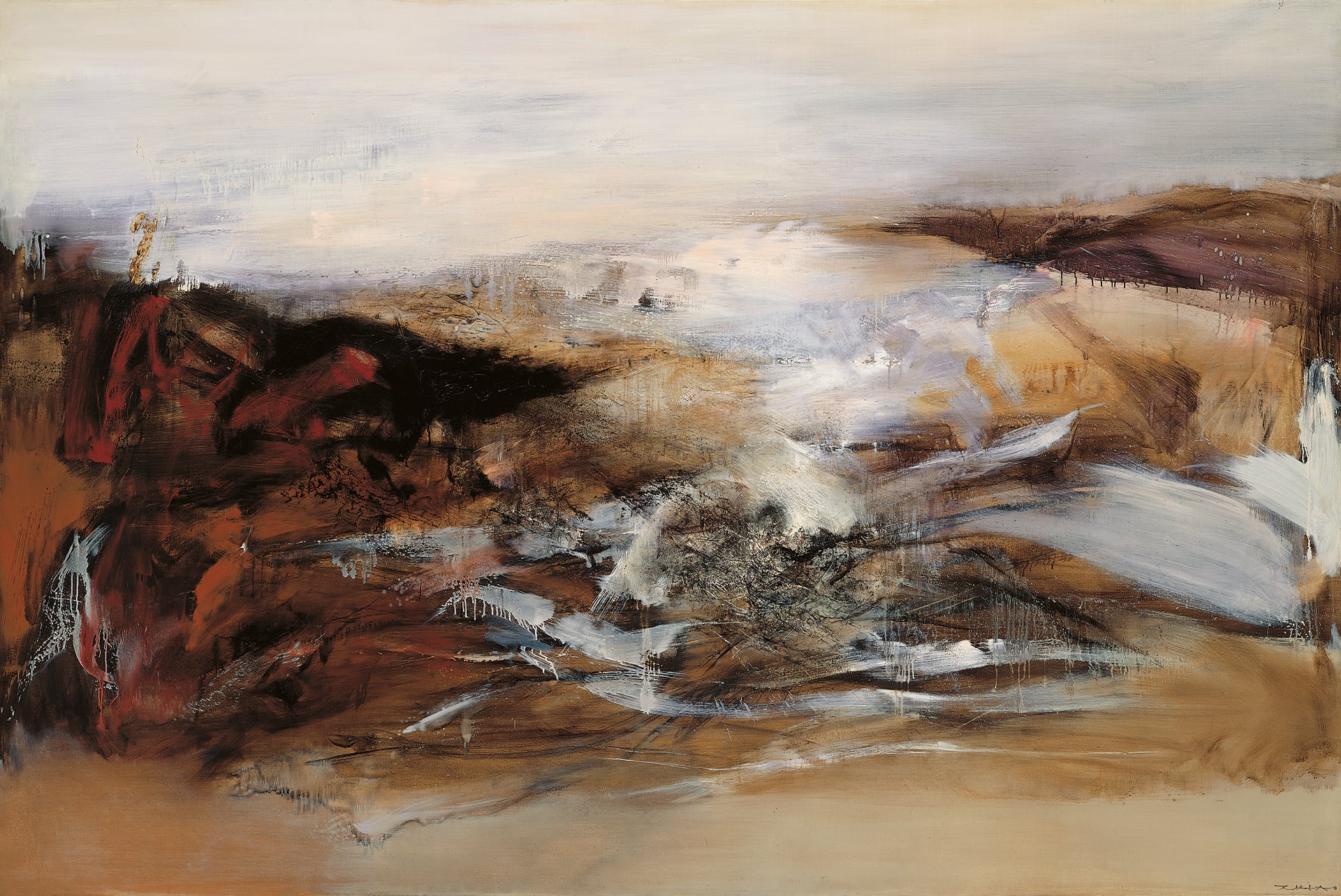
This broad composition is divided less by a line than by a change in pressure. Rust and black gather at the left, pale atmosphere opens above, and white strokes sweep through the lower field like currents crossing a vast terrain.

Zao's dated works resist a fixed story, but they are not detached from the world. Their scale and horizontal reach recall the long viewing experience of Chinese landscape painting while their physical brushwork belongs to the international language of postwar abstraction.

Look closely

  • Energy moving from the dark left edge toward open space
  • White strokes that cut across several depths at once
  • A landscape rhythm without a literal landscape
En memoire de May by Zao Wou-Ki, a very wide yellow, ochre, and black memorial painting
Artwork image courtesy Fondation Zao Wou-Ki. © Zao Wou-Ki - ProLitteris, Zurich.

08 / 1972

En mémoire de May - 10.03.72

Grief at monumental scale

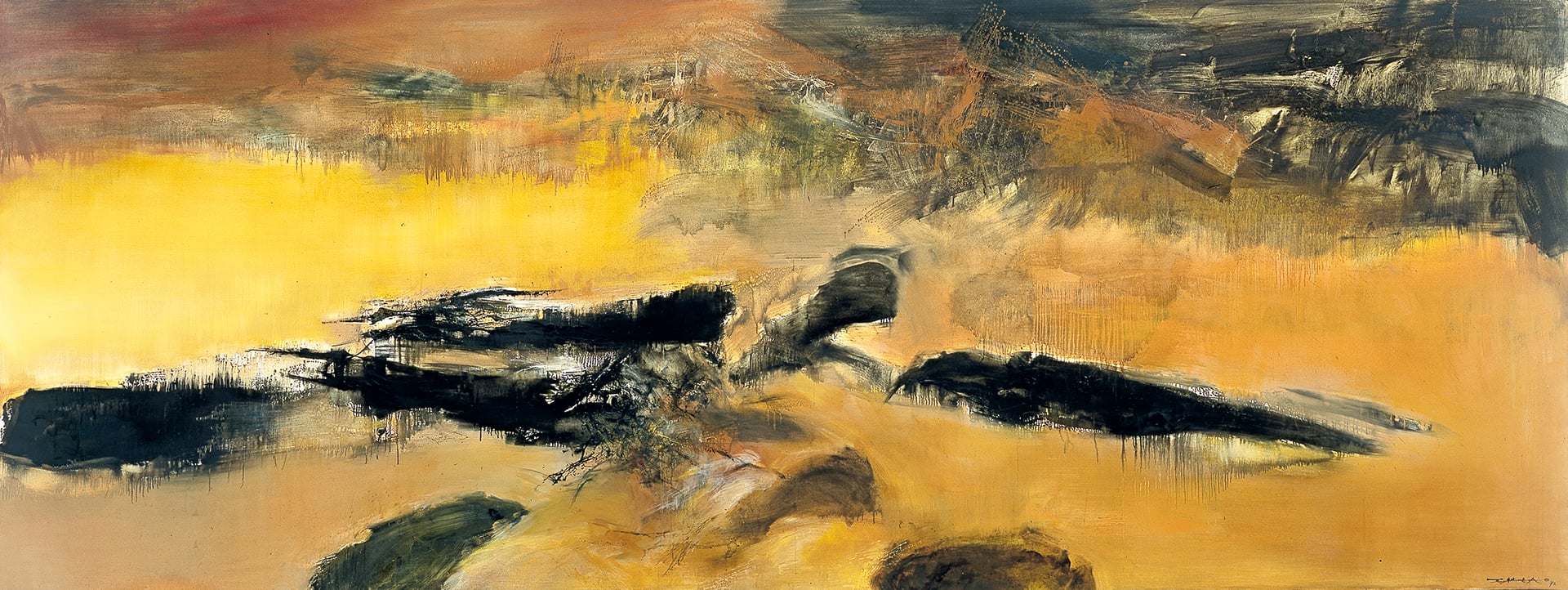
Zao made this immense memorial after the death of his second wife, Chan May-Kan, in 1972. The canvas extends more than five meters, carrying dark forms across an exposed yellow field. Its scale turns grief into a space the viewer must physically traverse.

He chose not to sell the work and donated it to the French state in 1973. The painting is personal, but it avoids portraiture and anecdote. Loss appears as imbalance: weight presses from above, black forms break apart, and luminous color becomes almost unbearable in its openness.

Look closely

  • Black forms suspended across a field of yellow
  • Drips and dragged edges that record physical strain
  • The emotional effect of the extreme horizontal format
Hommage a Henri Matisse I by Zao Wou-Ki, a vertical painting with a deep black center, blue left edge, and pink-white right edge
Artwork image courtesy Fondation Zao Wou-Ki. © Zao Wou-Ki - ProLitteris, Zurich.

09 / 1986

Hommage à Henri Matisse I - 02.02.86

An open door into color

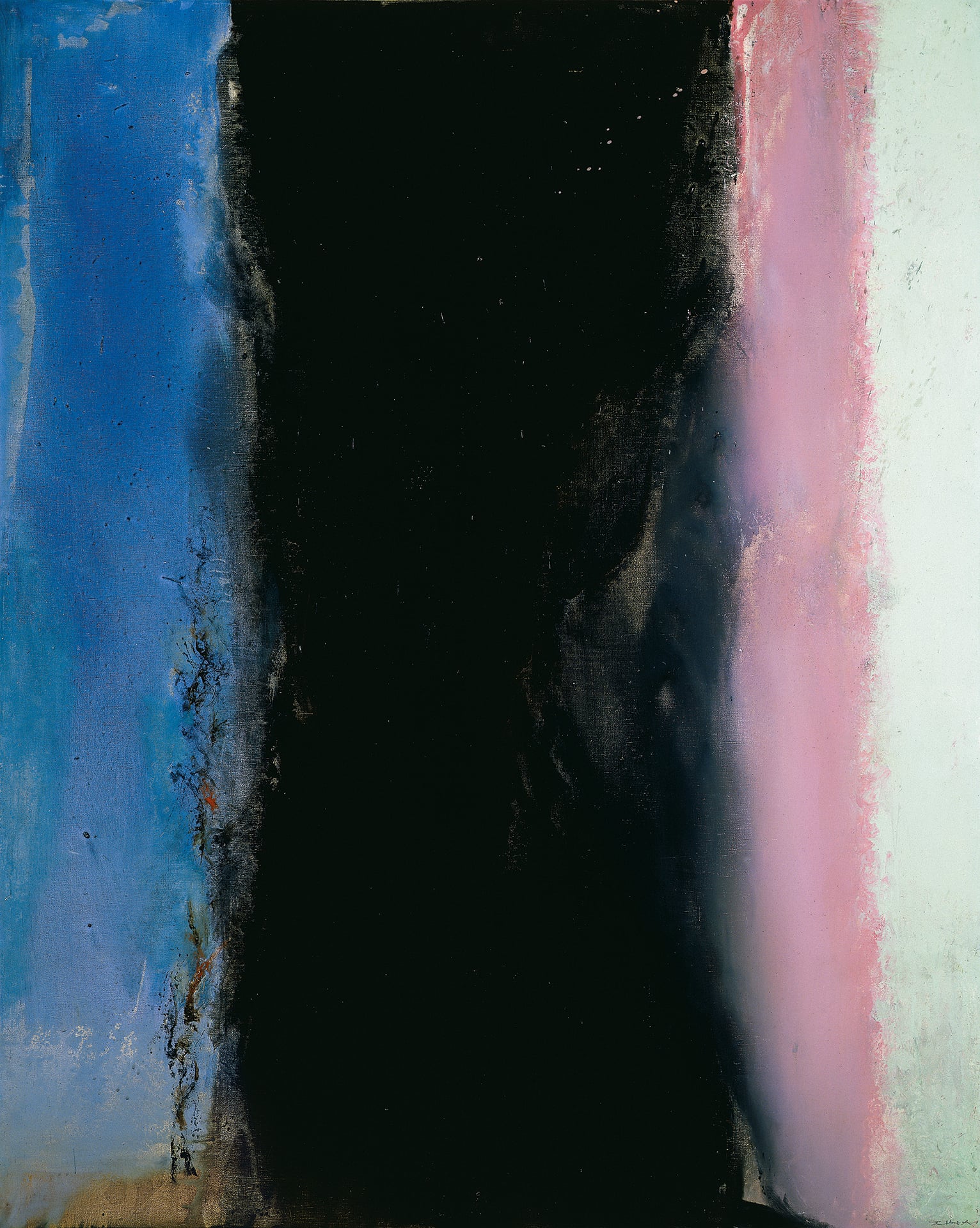
This tribute responds to Matisse's Porte-fenêtre à Collioure. A deep black center is held between blue, pink, and white vertical zones. The image is radically spare compared with Zao's turbulent paintings of the 1960s and 1970s.

The black field can be read as a doorway, a void, or pure pigment. Zao admired how Matisse made an apparently empty opening feel full of air, dust, and life. His homage turns that paradox into a concentrated meditation on presence and absence.

Look closely

  • The black center as both surface and depth
  • Soft borders where neighboring colors breathe into it
  • How restraint can create as much tension as gesture
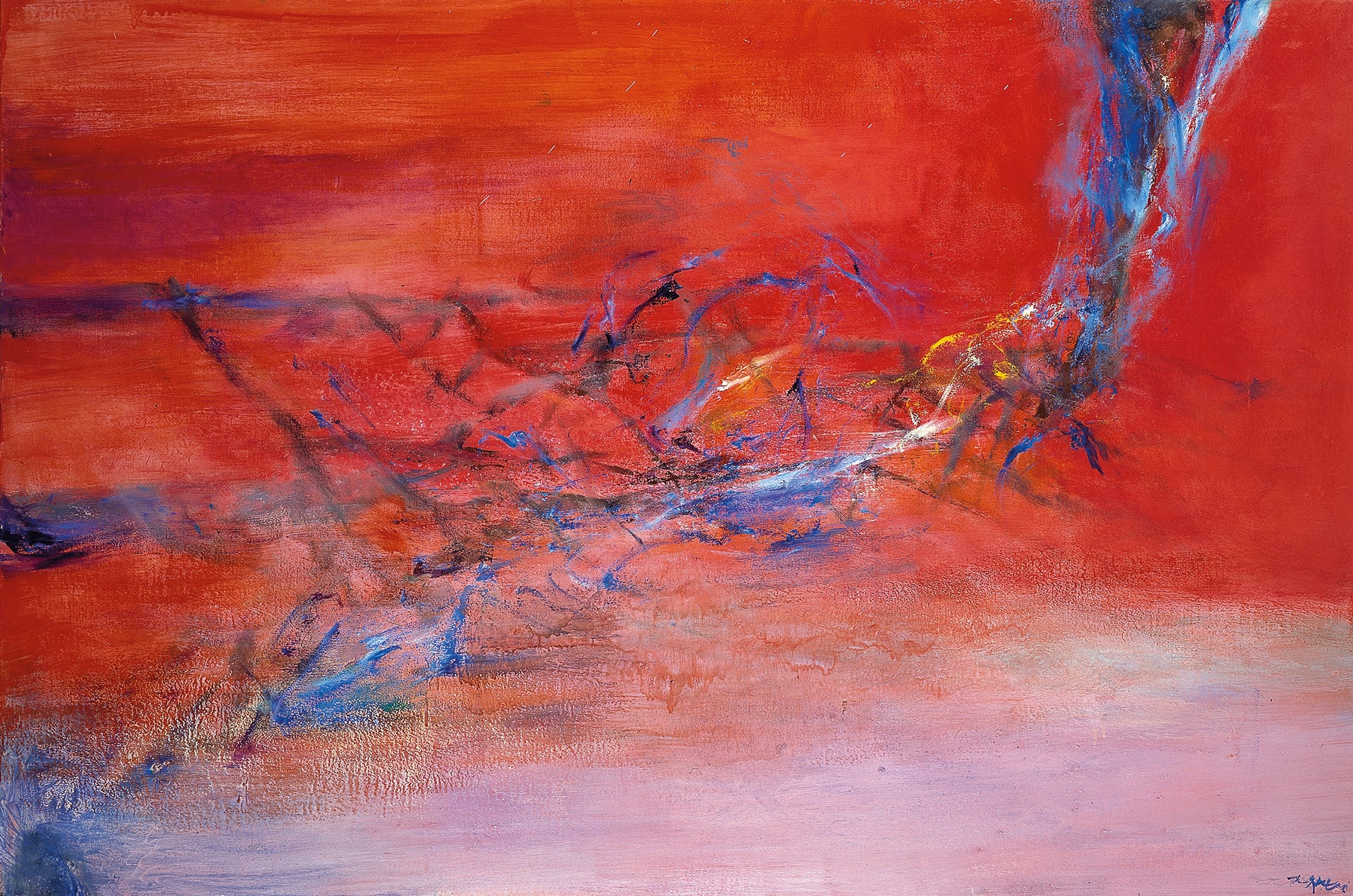
Terre rouge by Zao Wou-Ki, a vivid red abstract painting animated by blue, white, and yellow strokes
Artwork image courtesy Fondation Zao Wou-Ki. © Zao Wou-Ki - ProLitteris, Zurich.

10 / 2005

Terre rouge - 16.01.2005

Late color without hesitation

In his eighties, Zao's color could become startlingly direct. Terre rouge spreads red across almost the entire surface, then interrupts it with blue, white, yellow, and black movements. The image is expansive and playful rather than heavy.

The work shows the freedom of an artist no longer required to prove the legitimacy of his synthesis. Calligraphic energy, remembered landscape, and European oil painting no longer appear as separate sources. They have become one practiced language.

Look closely

  • Blue strokes cooling and redirecting the red field
  • Thin yellow accents that sharpen the central movement
  • A late-career lightness inside saturated color

03 / Historical background

Postwar modernism was never one place or one style.

The phrase postwar modernism often points toward Paris, New York, abstraction, and the years after 1945. For modern Chinese artists, that frame is necessary but incomplete. Their postwar world had been shaped by the fall of empire, Republican reform, colonial contact, Japanese invasion, forced migration, civil war, revolution, and competing ideas about what art should do for society.

Zao's career crosses those histories without resolving them into a simple East-West formula. He left China before the founding of the People's Republic, developed abstraction in Paris, engaged the New York School, remained active across Asian exhibition networks, and later returned to teach and exhibit in China. His art is transnational because his working world already was.

01

1912-1937

Reform before the war

After the Qing dynasty fell, artists and educators argued over how Chinese art could become modern without becoming culturally empty. Study in Japan and France, the May Fourth intellectual climate, and new academies in Shanghai and Hangzhou placed oil painting, life drawing, ink, and design in the same institutional conversation.
02

1937-1945

War moves the schools

The Sino-Japanese War scattered artists, collections, and academies. The Hangzhou school relocated deep inland, eventually reaching Chongqing. Modernism developed through evacuation, wartime teaching, propaganda demands, and the practical work of keeping cultural institutions alive.
03

1945-1949

A world reorganized

The end of World War II did not bring stability to China. Civil war resumed, while European cultural capitals rebuilt and the United States gained new influence. Artists who left, returned, or remained in China soon worked inside sharply different political and economic systems.
04

Late 1940s-1950s

Paris after the occupation

Postwar Paris remained a cosmopolitan contact zone even as New York challenged its authority. Art Informel, Tachisme, and lyrical abstraction favored gesture, matter, and open form. The broad label School of Paris included many foreign-born artists, but it could also flatten the cultural histories they carried with them.
05

1957-1965

The Atlantic conversation

Travel and galleries connected Paris to the New York School. Zao encountered the scale and spontaneity of American abstraction while maintaining a different spatial logic, one informed by calligraphic movement, shifting voids, and the long memory of Chinese landscape painting.
06

1949-1976

Diverging Chinese modernisms

In the People's Republic, socialist realism and political campaigns narrowed acceptable art, with the Cultural Revolution bringing persecution and long interruptions. In Taiwan, Hong Kong, Paris, and other diaspora centers, artists developed distinct modernisms shaped by migration, colonial histories, and new exhibition networks.
07

After 1978

Reopening and return

China's reopening renewed travel, teaching, exhibitions, and argument. Diaspora artists could return as honored visitors, while younger artists encountered abstraction through uneven channels. Modern Chinese art began to be narrated less as a closed national sequence and more as a network of routes, translations, and returns.
08

Today

A global history, not a bridge metaphor

Zao is often described as a bridge between East and West. The phrase is useful but incomplete: it can imply two fixed worlds and hide the many artists, publishers, museums, wars, friendships, and markets that made his language possible. His work is better understood as part of modernism's already global history.

04 / The wider study room

Zao first, then the connected lives around him.

These shorter profiles remain available while each artist receives the same work-by-work treatment in the next chapters of the study room.

02Sanyu 常玉

1895-1966

A Paris modernist who made line, the nude, flowers, and solitude feel inseparable.

Sanyu arrived in France through the work-study generation of the early 1920s. His calligraphic contour, spare grounds, and compressed interiors turned School of Paris subjects into a private language of elegance and precarity.

Open the full artist study
03Wu Guanzhong 吴冠中

1919-2010

Landscape modernism negotiated through oil, ink, political pressure, and return.

Wu trained in Hangzhou and Paris, then returned to China in 1950. Across decades of restriction and renewal, he argued that formal beauty, lived landscape, and abstraction could belong to the same modern Chinese practice.

Open the full artist study
04Chu Teh-Chun 朱德群

1920-2014

Luminous abstraction built from calligraphic force, weather, music, and deep space.

A fellow student of the Hangzhou academy generation, Chu moved to Paris in 1955. His mature paintings layer flashes of light and gestural structure into spaces that feel at once atmospheric, musical, and monumental.

Open the full artist study
05Lin Fengmian 林风眠

1900-1991

The artist-educator whose academy made cultural synthesis a working method.

Lin's teaching shaped Zao, Wu, Chu, and a much wider generation. His own square-format paintings condensed opera, birds, figures, folk color, ink, and European modernism into a resilient personal language.

Open the full artist study
06Pan Yuliang 潘玉良

1895-1977

A pioneering woman artist who made the body a question of authorship and modern freedom.

Pan studied in Shanghai and Europe, taught in China, and settled again in Paris in 1937. Her self-portraits and nudes join academic training, Chinese line, gendered scrutiny, and the difficult construction of an independent artistic life.

Open the full artist study

05 / Sources

Continue with the institutions behind the record.

Dates, dimensions, collection notes, and image identifications are based primarily on the Fondation Zao Wou-Ki chronology and works catalogue, supplemented by museum histories of twentieth-century Chinese art.