Chu Teh-Chun's Les Baigneuses, a figurative oil painting of bathers

Chu Teh-Chun / 朱德群

Chu Teh-Chun

The painter who turned calligraphic movement, weather, and remembered landscape into fields of illuminated abstraction.

Begin the life story
01

Les Baigneuses1951

1920-2014Baitu / Hangzhou / Taipei / ParisOil / Ink / Calligraphy / CeramicLyrical abstraction / light / landscape memory

01 / Biography

A life carried from wartime landscape to the scale and radiance of abstraction.

Chu's paintings were formed by a Chinese calligraphic education, forced migration across wartime China, the encounter with postwar Paris, and an enduring memory of mountains, rivers, snow, and changing light.

Chu did not abandon landscape when he became abstract; he relocated its weather, force, and spatial rhythm inside paint.

1920-1937

A calligraphic childhood and an avant-garde academy

Chu Teh-Chun was born in Baitu in northern Jiangsu, an area now administered as Anhui. His father and grandfather were traditional physicians and collectors of Chinese painting, and a tutor introduced the three sons to calligraphy and classical poetry. At fifteen Chu entered the Hangzhou Academy of Fine Arts under Lin Fengmian. The school placed drawing, oil painting, Chinese painting, and modern European art in active conversation. Chu studied ink with Pan Tianshou, learned Western techniques from teachers shaped by Paris and Dijon, and met Wu Guanzhong in 1936. Chu helped Wu prepare for the academy entrance examination, beginning a friendship that would outlast war, separation, and radically different careers.

1937-1948

The academy migrates, and landscape becomes lived geography

Japanese invasion forced the academy to leave Hangzhou in November 1937. Chu traveled with teachers and students through Zhejiang, Jiangxi, Hunan, Yunnan, and Sichuan before reaching wartime Chongqing. He sketched people and terrain along the route, graduated in 1941, and joined the faculty. He later taught architectural drawing at National Central University. A 1947 journey down the Yangtze impressed him with the river's immense spatial drama, though paintings entrusted to a friend or carried on the boat were lost. Returning home in 1948, he learned that his father and a brother had died during the war. These years made landscape inseparable from movement, loss, and memory rather than an inherited pictorial category alone.

1949-1955

Taipei, teaching, and a sold-out departure

Chu and his first wife, Liu Hanfu, left Nanjing for Taipei at the end of 1949. He taught drawing in architecture and fine-art departments, worked alongside painters debating modern abstraction in Taiwan, and continued to make figurative oils of mountains, still lifes, and nudes. His first solo exhibition at Taipei's Sun Yat-sen Hall in 1954 sold out. The proceeds paid for passage to France and supported his first Paris years. When he sailed in March 1955, his move belonged to the same transnational history that had carried Sanyu, Pan Yuliang, Lin Fengmian, and Zao Wou-Ki to Europe, but it occurred after war had divided their generation into new political and geographic conditions.

1955-1978

Paris loosens the figure and calligraphy enters abstraction

Chu arrived in Marseille in May 1955 and settled in a small room on rue Lhomond. He drew at the Grande Chaumiere, reconnected with Zao Wou-Ki, and met Paris-based Chinese artists including Sanyu and Pan Yuliang. Encounters with Goya, El Greco, and especially Nicolas de Stael helped him move beyond descriptive figuration in 1956. Galerie Legendre offered him an exclusive contract in 1958 and presented his first all-abstract solo exhibition. Broad masses soon gave way to quicker signs, layered darkness, and eruptive color. Around 1971 he resumed daily calligraphy, not as an ornamental quotation but as a discipline of pressure, speed, suspension, and breath that could reorganize the entire painted field.

1978-1997

Recognition, return to China, and snow as an event of light

A 1978 retrospective in Saint-Etienne marked widening institutional recognition; Chu became a French citizen in 1981. In 1983 he returned to China for the first time in thirty-five years, reunited with family and former colleagues, and visited the Yellow Mountains. The journey refreshed landscapes long held in memory and renewed his wash drawings. Two years later, a sudden snowstorm seen while traveling back from Geneva initiated the celebrated winter paintings. White was no longer blankness or surface highlight. It became suspended weather, a moving veil that opened depth among dark strokes and incandescent color. Larger studios allowed increasingly monumental canvases, culminating in his 1997 election to the Academie des Beaux-Arts as its first member of Chinese origin.

1997-2014 and after

Monumental commissions, public recognition, and a broad material legacy

Chu's late practice moved easily among large oils, ink washes, calligraphy, and ceramics. The Shanghai Grand Theatre commissioned Symphonie Festive, a four-by-seven-metre canvas painted in 2002 and 2003, while the Manufacture de Sevres invited him to work across fifty-eight porcelain vases between 2007 and 2009. Retrospectives in Beijing, Taipei, Shanghai, Paris, and elsewhere made his career central to the history of postwar abstraction. He died in Paris in 2014. The Fondation CHU Teh-Chun now documents a body of more than 2,500 works, preserving evidence that his art was not a single formula of East meeting West but a sustained investigation of energy, atmosphere, scale, and light.

02 / Selected works

Ten works from figuration to weather, radiance, and scale.

Follow Chu as bodies and flowers dissolve into mobile signs, darkness becomes spatial, and remembered landscape returns through autumn, snow, roses, and traversing light.

Chu Teh-Chun's Les Baigneuses, a figurative oil painting of bathers
Image reference: Fondation CHU Teh-Chun. Educational presentation.

01 / 1951

Les Baigneuses

Before abstraction, the body is already a structure of rhythm

Painted during Chu's Taiwan years, Les Baigneuses belongs to the figurative foundation from which his abstraction emerged. Bodies are simplified and compressed within a modest canvas. Color blocks and contours carry as much weight as anatomical description, showing an artist already interested in how figures lock together across a surface.

The subject recalls a long European tradition, but Chu's handling avoids academic finish. Space is shallow, edges remain active, and the arrangement reads almost like a compact sequence of written forms. The later abstract painter is visible not because the image predicts a style, but because rhythm has begun to outrank narrative.

Look closely

  • Bodies joined by repeated curves rather than separated portraits
  • Warm and cool color areas organizing the shallow space
  • Brushwork that keeps contour mobile instead of polished
Chu Teh-Chun's Serie de fleurs III, a near-square floral oil painting
Image reference: Fondation CHU Teh-Chun. Educational presentation.

02 / 1957

Serie de fleurs III

Flowers become the threshold between object and sign

Made two years after Chu reached Paris, this floral painting sits at the edge of his decisive transformation. Stem, blossom, and vessel remain legible, but their boundaries loosen into a web of marks. Color no longer simply fills an observed object; it produces a field in which the object can appear and recede.

The painting is useful precisely because it resists a tidy before-and-after story. Chu did not switch from figuration to abstraction overnight. He tested how much recognition a picture needed, and how line could retain the memory of a thing while acting independently across the canvas.

Look closely

  • Floral forms dissolving at their edges
  • Dark lines connecting rather than outlining objects
  • Color functioning as atmosphere as well as local description
Chu Teh-Chun's No. 208 Automne, an abstract oil in autumnal colors
Image reference: Fondation CHU Teh-Chun. Educational presentation.

03 / 1965

No. 208 Automne

Autumn survives as temperature rather than scenery

By 1965 Chu had committed to abstraction, yet the title Automne keeps the painting attached to seasonal experience. Dense dark passages are crossed by warmer notes and quick linear incidents. Autumn is not represented through trees or leaves; it is reconstructed as a pressure among ember-like color, shadow, and declining light.

Number and title point in different directions. The number belongs to the serial discipline of postwar abstraction, while the word autumn invites memory and sensation. Chu keeps both, refusing the claim that an abstract painting must be sealed off from the world that prompted it.

Look closely

  • Warm color held inside a darker spatial field
  • Marks that accelerate near the center
  • Edges that remain quieter than the compressed interior
Chu Teh-Chun's Signe en mouvement, an abstract oil of moving dark signs
Image reference: Fondation CHU Teh-Chun. Educational presentation.

04 / 1967

No. 239 Signe en mouvement

The brushmark behaves like writing without becoming a word

Signe en mouvement names the central problem directly: a sign can carry gesture, direction, and weight without settling into language. Dark strokes cross the square field at different speeds, while lighter passages push from behind. The canvas reads as an event unfolding rather than a fixed arrangement.

Chu's calligraphic inheritance matters here, but the painting is not enlarged calligraphy. Oil has drag, opacity, and the power to bury earlier decisions. He uses those properties to make movement layered and spatial, as if a written impulse had passed through weather and geological pressure.

Look closely

  • A square support resisting the diagonal force of the marks
  • Thin signs cutting across heavier painted masses
  • Light appearing to originate behind the surface
Chu Teh-Chun's Composition no. 554, a large abstract oil of light and dark currents
Image reference: Fondation CHU Teh-Chun. Educational presentation.

05 / 1974

Composition no. 554

Calligraphic energy expands into a panoramic field

At nearly two metres wide, Composition no. 554 lets Chu distribute energy across bodily scale. Dark structures gather, separate, and rejoin while light opens passages through them. The viewer cannot take in the work as a single emblem; the eye must travel, pause, and change direction.

Chu had resumed calligraphic practice around 1971, and the painting translates that renewed discipline into spatial orchestration. A stroke is never isolated. Each one answers the density, interval, and direction of its neighbors, allowing the whole canvas to breathe like an extended phrase.

Look closely

  • Alternation between compressed knots and open intervals
  • Long trajectories that pull vision laterally
  • Small warm notes preventing the dark structure from closing
Chu Teh-Chun's Le pays secret, a large abstract diptych
Image reference: Fondation CHU Teh-Chun. Educational presentation.

06 / 1981

Le pays secret

A diptych makes landscape feel discovered rather than described

The secret country of the title is neither a mapped territory nor pure fantasy. Two canvases create a hinge through the center, making the field feel both continuous and divided. Dark forms suggest cliffs, cloudbanks, or deep water without resolving into any one of them.

The work was painted as Chu renewed links with China and prepared for his first return. Its space can therefore be read as a country carried through memory, though the painting refuses illustration. What remains is a structure of approach: obscurity, opening, distance, and sudden illumination.

Look closely

  • The central seam acting as both break and passage
  • Light gathering where solid geography might be expected
  • Scale that places the viewer inside rather than before the field
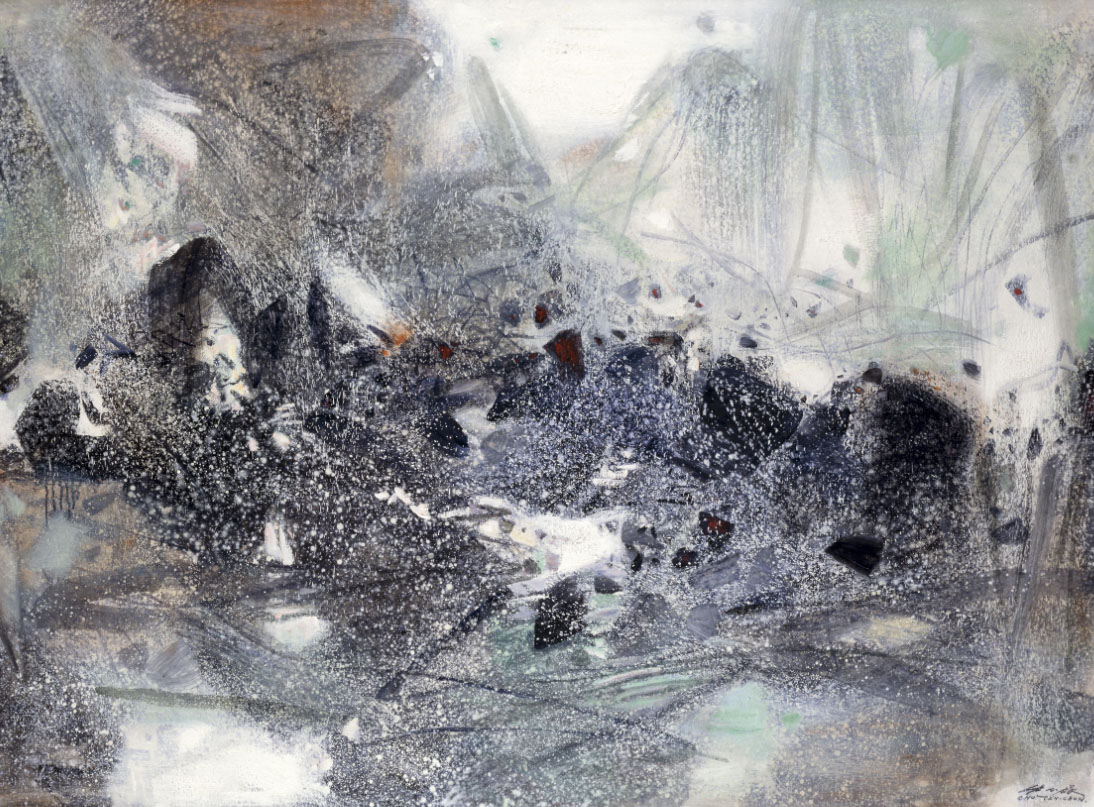
Chu Teh-Chun's Nature hivernale A, an abstract winter painting with suspended white marks
Image reference: Fondation CHU Teh-Chun. Educational presentation.

07 / 1985

Nature hivernale A

Snow turns white paint into moving atmosphere

A snowstorm encountered after a Geneva exhibition in 1985 changed Chu's treatment of white. In Nature hivernale A, pale flecks and veils move across a dark, spacious field. They do not sit on top like decorative snowfall; some advance sharply while others dissolve into depth.

Winter gives Chu a way to join Chinese ideas of reserve and void to the material fullness of oil. White can be mark, air, obstruction, and light at once. The painting's weather is convincing because no single layer controls it: space forms through accumulation and partial concealment.

Look closely

  • Different sizes and densities of white creating several depths
  • Dark forms that remain unstable behind the snowfall
  • Warm light surviving within an otherwise cold field
Chu Teh-Chun's Harmonie Hivernale, a monumental abstract winter triptych
Image reference: Fondation CHU Teh-Chun. Educational presentation.

08 / 1986

Harmonie Hivernale

Winter becomes monumental, continuous, and symphonic

Harmonie Hivernale extends the snow discovery across nearly four metres. The triptych format introduces two vertical seams, yet the storm passes through them. Chu uses repetition and variation like musical development: white flurries gather, disperse, and return against changing darkness.

The title's harmony should not be confused with calm. The painting contains collisions, deep shadows, and sudden brightness. Harmony is achieved by holding opposing forces in one duration, an idea that links Chu's love of classical music to the responsive balance of calligraphic composition.

Look closely

  • Snowfall changing tempo from panel to panel
  • Seams dividing the support but not the weather
  • Bright passages that seem to open and then close again
Chu Teh-Chun's Traversee de la lumiere, an abstract painting crossed by luminous color
Image reference: Fondation CHU Teh-Chun. Educational presentation.

09 / 1991

Traversee de la lumiere

Light is a journey through matter, not an effect laid upon it

The title describes a crossing: light travels through darkness rather than merely illuminating it from outside. Chu builds the surface in layers so that radiance appears earned, forced through resistant matter. The modest dimensions intensify this concentration.

By 1991 the artist had a larger Vitry studio and was beginning a period of monumental work, yet this canvas shows that scale alone did not produce expansiveness. Direction, interval, and the pressure between opacity and translucency can make a smaller painting feel cosmological.

Look closely

  • A luminous route that never becomes a straight line
  • Dark pigment acting as depth rather than empty background
  • Fine marks registering changes in speed around the light
Chu Teh-Chun's Le langage des roses, a panoramic late abstract painting
Image reference: Fondation CHU Teh-Chun. Educational presentation.

10 / 2005

Le langage des roses

A late panorama lets color speak without becoming a flower painting

Le langage des roses returns to a floral title almost five decades after Serie de fleurs III. No bouquet appears. Rose, crimson, green, and darkness move across a panoramic support as if the sensory memory of flowers had expanded into climate.

The painting demonstrates the openness of Chu's late language. Calligraphic direction remains, but signs are absorbed into broad chromatic atmosphere. The roses speak through recurrence, blooming intensity, and fading rather than through depiction, completing a long movement from object to embodied sensation.

Look closely

  • Rose color appearing in several intensities rather than one local hue
  • A panoramic rhythm that cannot be centered in a single focal point
  • Dark passages giving brightness room to expand

03 / Historical background

Chu's abstraction belongs to war, migration, Paris, and renewed transnational exchange.

Chu's career crosses the Republican academy, the forced inland migration of the Sino-Japanese War, post-1949 Taiwan, and the international art world of postwar Paris. These settings changed his access to teachers, landscapes, exhibitions, materials, and audiences. They also complicate the easy label of a painter who simply combined East and West.

His mature art was produced in Paris, but it remained answerable to calligraphy learned in childhood and geography encountered across China. Later returns to the Yellow Mountains and commissions in Shanghai did not close a circle. They reveal a modernism sustained by repeated movement among memory, place, institution, and medium.

01

1920-1937

Republican academies make comparison a method

The Hangzhou Academy treated oil painting, drawing, ink, and design as parts of one modern curriculum. Under Lin Fengmian, young artists learned that tradition and European modernism were not fixed camps but materials to be tested through practice.
02

1937-1945

War moves the school across the country

Japanese invasion forced the academy inland for three years. Education continued through displacement and scarcity. For Chu, Wu, and their classmates, landscape was physically traversed during national emergency, giving later pictorial space a history of travel and loss.
03

1949-1955

Taiwan becomes a laboratory for modern painting

Artists, teachers, and institutions moved to Taiwan after the Chinese Civil War. Chu taught there as debates over national culture and abstraction developed. A successful solo exhibition made his privately financed departure for France possible.
04

1955-1968

Postwar Paris is international, competitive, and plural

Paris no longer held an uncontested monopoly on modern art, but galleries, salons, museums, and expatriate networks still drew artists from across the world. Chu encountered European abstraction while maintaining close ties to Chinese artists already in the city.
05

1968-1981

Calligraphy returns inside the abstract field

The post-1968 art world widened beyond a single school of Paris. Chu's renewed calligraphic practice around 1971 deepened the movement and spacing of his oils. Recognition grew through European exhibitions and a 1978 retrospective rather than through one manifesto or group identity.
06

1981-1997

Reform-era exchange reopens routes to China

French citizenship, travel, and China's reopening made return possible. Chu's 1983 visit joined emotional reunion to renewed visual study. The winter series and large canvases of the following years transformed weather and remembered geography into monumental abstraction.
07

1997-2009

Institutions recognize a transnational modernist

Election to the Academie des Beaux-Arts, major Asian retrospectives, the Shanghai Grand Theatre commission, and the Sevres project placed Chu across French and Chinese public institutions. His work could no longer be contained by the category of expatriate painter alone.
08

After 2014

A foundation turns a prolific career into a research record

The Fondation CHU Teh-Chun documents works, exhibitions, archives, rights, and provenance. Its record makes it possible to compare figuration, oils, paper, calligraphy, and ceramics rather than reducing Chu to a few spectacular late canvases.

04 / The wider study room

Shared teachers, diverging geographies, different freedoms.

Chu becomes clearer beside friends and predecessors who crossed the same schools, wars, cities, and media but made different choices about return, settlement, and abstraction.

01Zao Wou-Ki 赵无极

1920-2013

A Hangzhou classmate in spirit whose Paris abstraction opened signs into vast atmospheric space.

Chu reconnected with Zao on arriving in Paris. Both carried Lin Fengmian's comparative education into postwar abstraction, yet their color, mark, scale, and career networks remained distinctly their own.

Open the full artist study
02Sanyu 常玉

1895-1966

An earlier Paris modernist who condensed bodies, flowers, and animals into calligraphic contour.

Chu met Sanyu in Paris in 1955. Sanyu's intimate, often precarious career shows an earlier expatriate route, while Chu's gallery contract and later institutions reveal how the Paris art world had changed.

Open the full artist study
03Wu Guanzhong 吴冠中

1919-2010

Chu's lifelong friend, who returned from Paris and remade Chinese landscape in oil and ink.

Chu helped Wu enter the Hangzhou academy. Wu returned to China in 1950, while Chu left Taiwan for Paris in 1955. Their parallel commitment to landscape exposes how politics and place shaped shared formal questions.

Open the full artist study
04Lin Fengmian 林风眠

1900-1991

The artist-educator who made comparative modernism foundational at Hangzhou.

Lin's school gave Chu permission to treat Chinese and European art as living problems. Their 1979 reunion in Paris joined the teacher who endured political persecution in China to a student recognized abroad.

Open the full artist study
05Pan Yuliang 潘玉良

1895-1977

A painter and sculptor whose Paris practice joined the modern nude to a new fine-line language.

Pan was part of the Chinese artistic community Chu encountered in Paris. Her earlier studies and long expatriate life widen the story beyond male abstraction and show another way Chinese line entered European media.

Open the full artist study

05 / Sources

Continue with the museums and archives behind the record.

Biography, chronology, artwork dimensions, and image identifications draw primarily on the Fondation CHU Teh-Chun, supplemented by French institutional records.