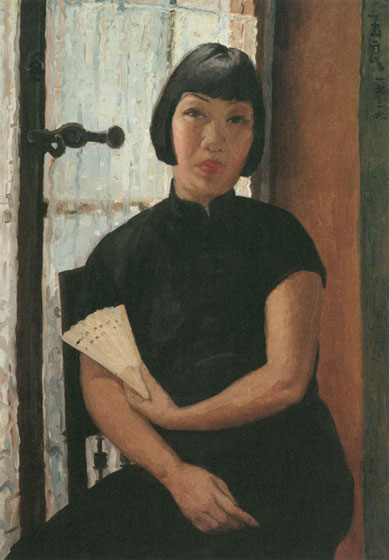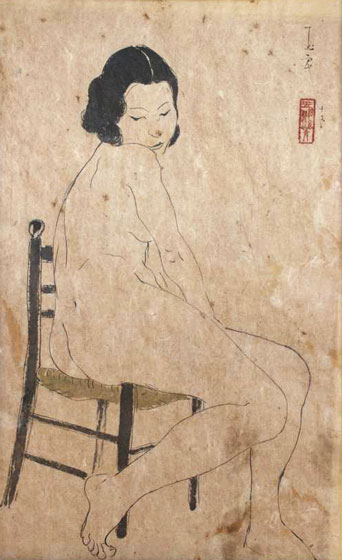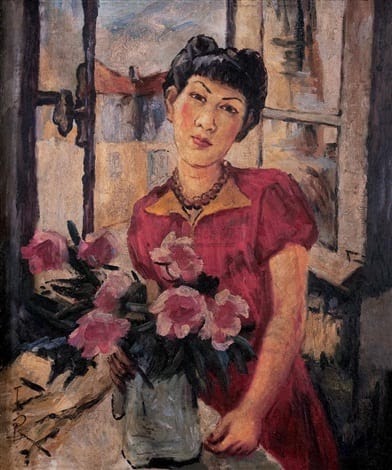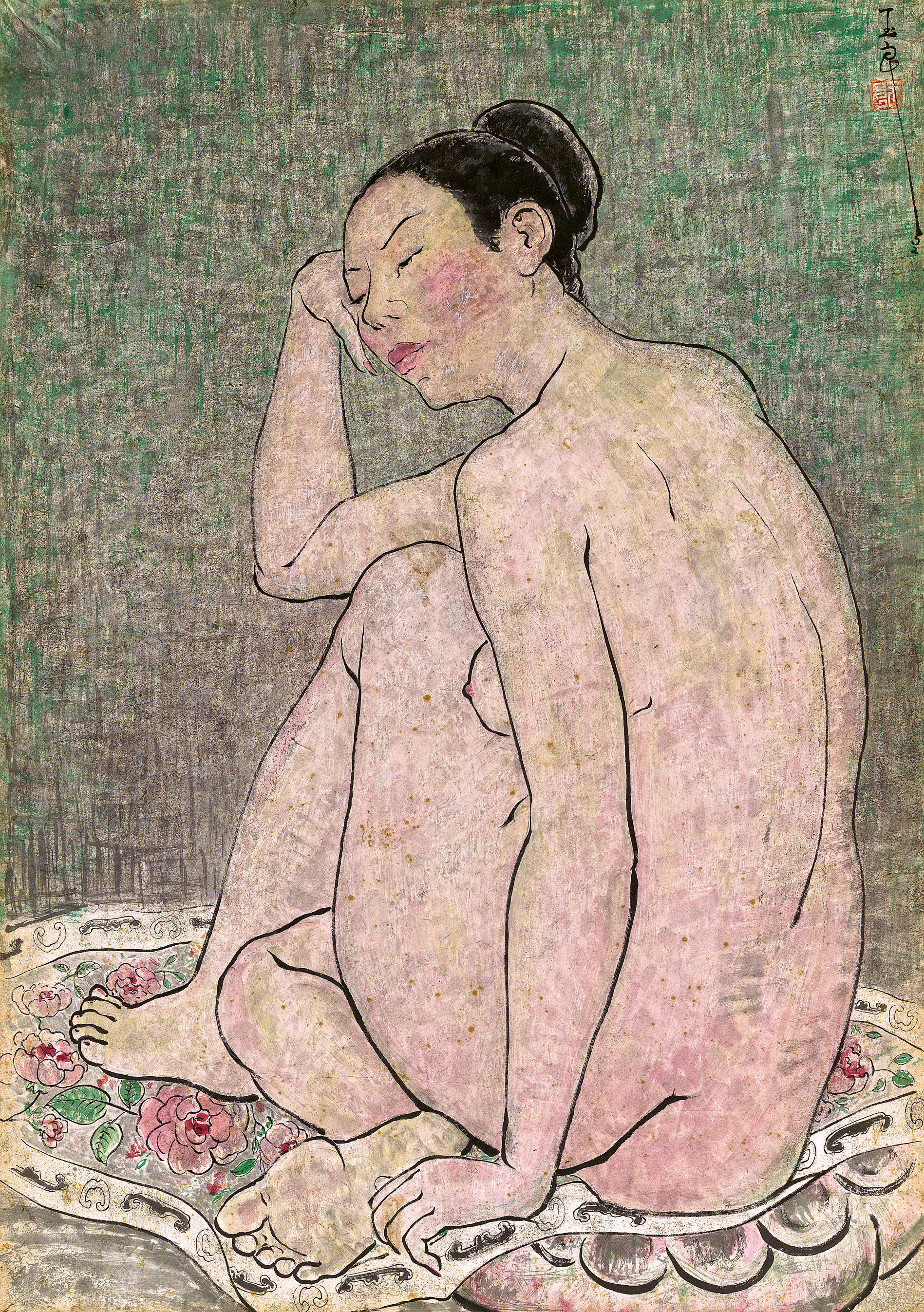
Pan made women visible not only as bodies represented in modern art, but as the makers, viewers, workers, friends, and authors of those bodies.
1895-1920
Orphanhood, uncertain records, and entry into Shanghai art education
Pan Yuliang was born Zhang Shixiu in Yangzhou; a research chronology based on Chinese records gives June 14, 1895, while several French museum records use 1894. She lost both parents in childhood. Later accounts agree that an uncle sold her, but disagree on whether she entered a brothel or worked as a servant; novels, films, and biographies have often turned that uncertainty into melodrama. What can be documented is her relationship with the customs official and revolutionary Pan Zanhua, whose surname she adopted and whose support enabled further education. After periods in Wuhu, Beijing, and Shanghai, she studied with Hong Ye and entered the Western Painting Department of Shanghai Art School in 1920 under the name Pan Shixiu. Her class was the school's first coeducational cohort, and she joined an unprecedented mixed-gender sketching trip to Hangzhou. Access to the life class and public art education was itself a claim to modern citizenship for a woman of her background.1921-1928
Lyon, Paris, Rome, and professional formation across three academies
Pan passed the entrance examination for the Institut Franco-Chinois de Lyon in 1921 and sailed with more than one hundred students. She studied drawing and oil painting in Lyon, moved to Paris in 1922, and entered the Ecole nationale superieure des Beaux-Arts in 1924 after working in Lucien Simon's studio. Her circle included Fang Junbi, Sanyu, and other Chinese artists negotiating European academic and modern art. In 1925 she went to Rome to study painting and sculpture, supported in part by an Italian government scholarship, and received recognition at an international exhibition. Hundreds of works sent toward China in 1926 were destroyed in a shipboard fire. She returned to Shanghai in 1928 with rigorous training across oil, drawing, and sculpture, then mounted a solo exhibition of eighty works.1928-1937
Teaching, exhibitions, and the contested modern nude in Republican China
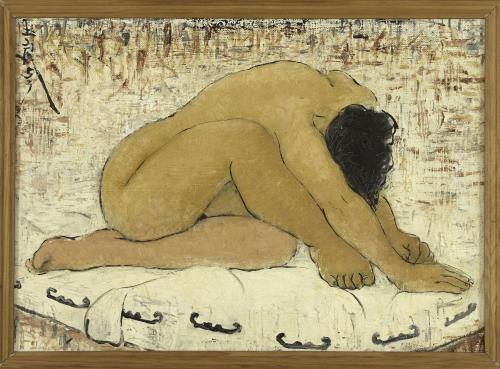
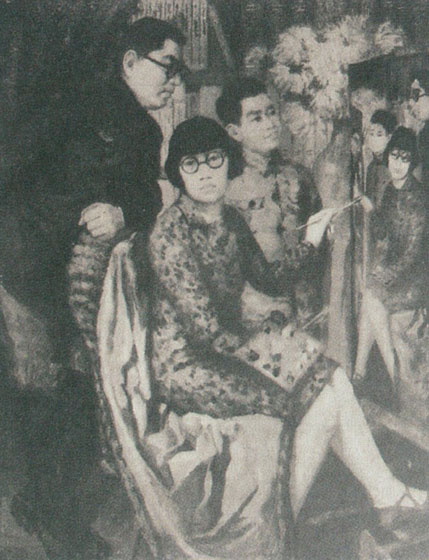
Pan headed or taught Western painting at Shanghai Art School, Shanghai Art University, Xinhua Art School, and National Central University in Nanjing. She participated in national exhibitions, traveled with students and colleagues, published an oil-painting album, and joined several important artist associations. Her nudes drew attention because they entered a culture where life drawing, coeducation, and women's bodily autonomy were still publicly contested. As a woman painting the nude and teaching from the model, Pan occupied both sides of a visual relation usually controlled by men. Critics also weaponized stories about her early life, making gender and class inseparable from the reception of her art. Her fourth and final Chinese solo exhibition in Nanjing in 1937 presented 170 works, including fine-line figure drawings that Chen Duxiu praised for joining European form to Chinese linear discipline.1937-1949
A planned journey becomes permanent Paris exile
Pan left China in July 1937 intending to spend roughly two years traveling and renewing her work. Full-scale war in China and then Europe made return impossible, and she settled near the Academie de la Grande Chaumiere in Montparnasse. She exhibited in the Salon des Tuileries, survived wartime displacement and occupied Paris, and supported relief efforts for women and children affected by the Sino-Japanese War. French state collections acquired ink works in 1942 and 1946. Pan became an active member and then president of the Association of Chinese Artists in France, linking artists who returned to China with those who remained abroad. A 1948 embassy exhibition placed her with Sanyu, Zao Wou-Ki, and Xiao Lingzhuo, showing how varied the category of Chinese art in Paris had become.1949-1963
New fine-line painting, sculpture, printmaking, and the Paris studio
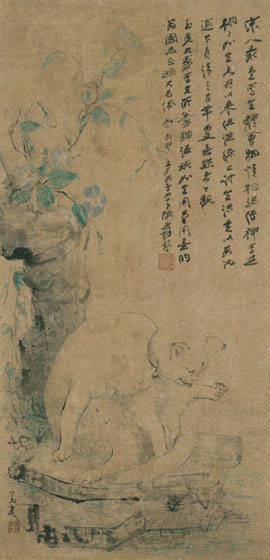
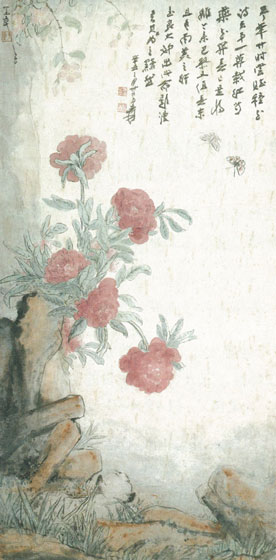
Postwar Paris was artistically active but economically difficult. Pan worked across media, explaining that sculpture could sometimes provide more income than painting. She made portrait busts of friends and public figures, produced forty-two relief prints in 1952, and held major solo exhibitions in 1953 and 1957. In ink-and-color nudes, fine repeated lines model flesh without enclosing it inside academic contour. These marks derive from Chinese linear traditions but are deployed across bodies informed by European life study, Fauvist color, and the spatial freedom of paper. She painted women bathing, resting, reading, posing, and socializing, making the nude a broad field of everyday embodiment rather than a single erotic spectacle. Exhibitions in Europe, Britain, Greece, San Francisco, and New York extended her network beyond the Paris salons.1963-1977 and after