Modern Chinese ArtistsObject Study 05

Lin Fengmian / 林风眠

Landscape

1940s

Oil begins to think in the compact space of ink landscape

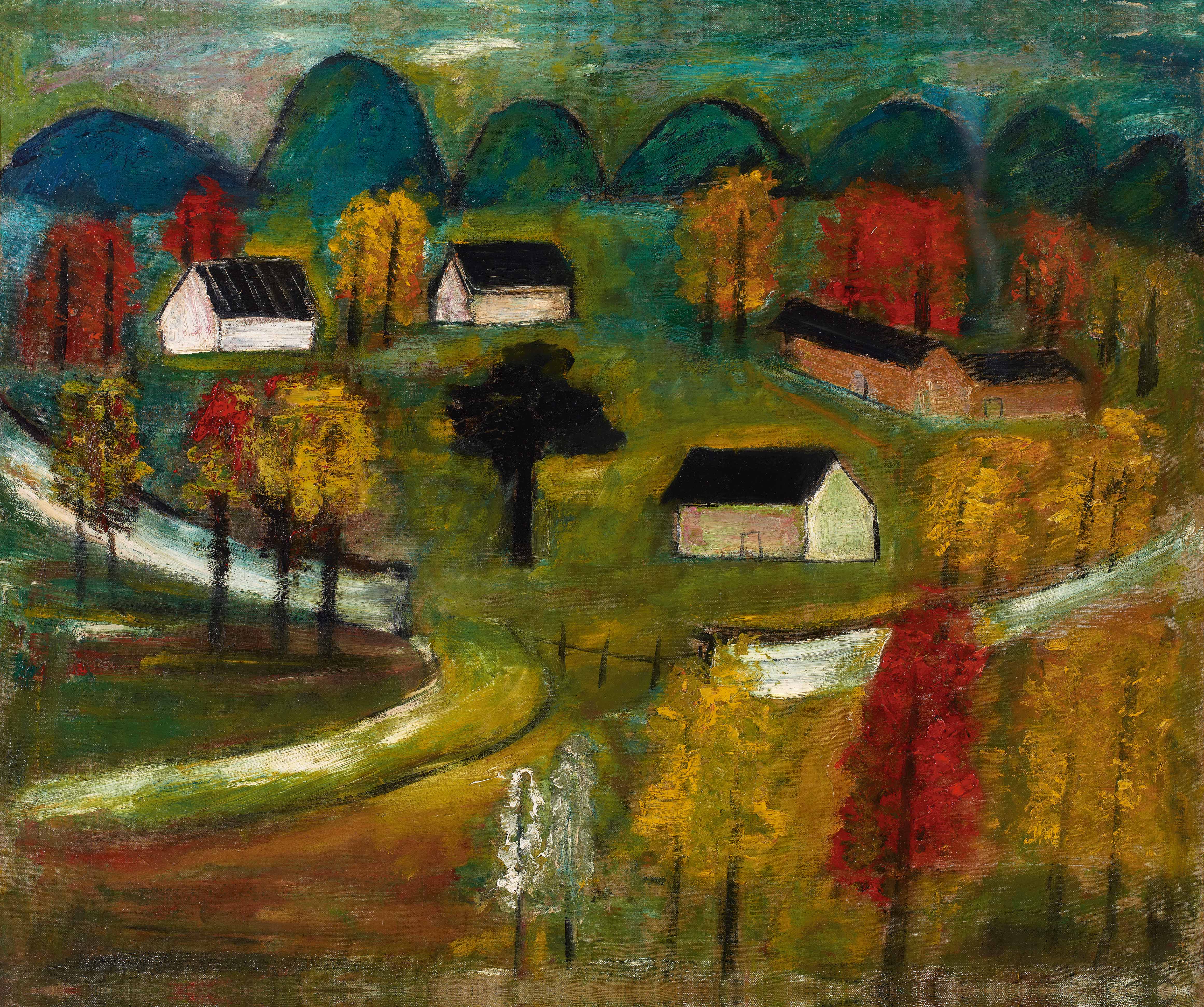
Lin Fengmian's Landscape, an oil painting of mountain, water, trees, and houses
Image reference: Taikang Art Museum. Educational presentation.
Landscape100%
Lin Fengmian's Landscape, an oil painting of mountain, water, trees, and houses

Use the controls or mouse wheel to zoom. Drag the image when enlarged.

Enter the artwork study
01

Object in the Lin Fengmian study

Date
1940s
Medium
Oil on canvas
Dimensions
54.6 x 66.7 cm
Collection / record
Taikang Art Museum
Catalogue / accession
Taikang Collection

01 / Why this work matters

Oil begins to think in the compact space of ink landscape

This wartime or immediate postwar landscape belongs to the transition between Lin's early expressionist oils and his mature ink-and-color paintings. Mountain, river, village, and trees remain recognizable, but they are compressed into a near-square field whose warm and cool areas carry the construction.

Although painted in oil, the work avoids heavy modelling. Distant mountains and pale water are treated as intervals, while black trees provide a calligraphic center. Lin is not making European oil imitate an old Chinese scroll; he is testing how oil can support mobile viewpoints and a concentrated poetic space.
02 / Formal analysis

Five ways to read the visible evidence.

Move from color and composition toward the material surface and the space the work asks you to inhabit.
01

Color and light

Dark trees acting as the structural hinge

02

Composition and rhythm

White houses punctuating the middle distance

03

Line and gesture

Warm foliage crossing a cool mountain-and-water field

04

Surface and material

Although painted in oil, the work avoids heavy modelling. Distant mountains and pale water are treated as intervals, while black trees provide a calligraphic center. Lin is not making European oil imitate an old Chinese scroll; he is testing how oil can support mobile viewpoints and a concentrated poetic space.

05

Space and scale

This wartime or immediate postwar landscape belongs to the transition between Lin's early expressionist oils and his mature ink-and-color paintings. Mountain, river, village, and trees remain recognizable, but they are compressed into a near-square field whose warm and cool areas carry the construction.

03 / History and object record

Place the image inside a life, a period, and a documented record.

Historical interpretation

Lin Fengmian, 1940s

Although painted in oil, the work avoids heavy modelling. Distant mountains and pale water are treated as intervals, while black trees provide a calligraphic center. Lin is not making European oil imitate an old Chinese scroll; he is testing how oil can support mobile viewpoints and a concentrated poetic space.

The painter and educator who made the square sheet a meeting place for color, ink, opera, folk form, and European modernism.

Exhibition and record history

What the cited record establishes

Recorded collection
Taikang Art Museum
Catalogue reference
Taikang Collection
Exhibition chronology
The cited public record does not provide a complete exhibition chronology. Follow the primary record for provenance, display history, and future updates.

04 / Connections

Continue through neighboring works and parallel modernisms.

05 / Sources and further reading

Follow the object back to its institutional record.