Modern Chinese ArtistsObject Study 01

Zao Wou-Ki / 赵无极

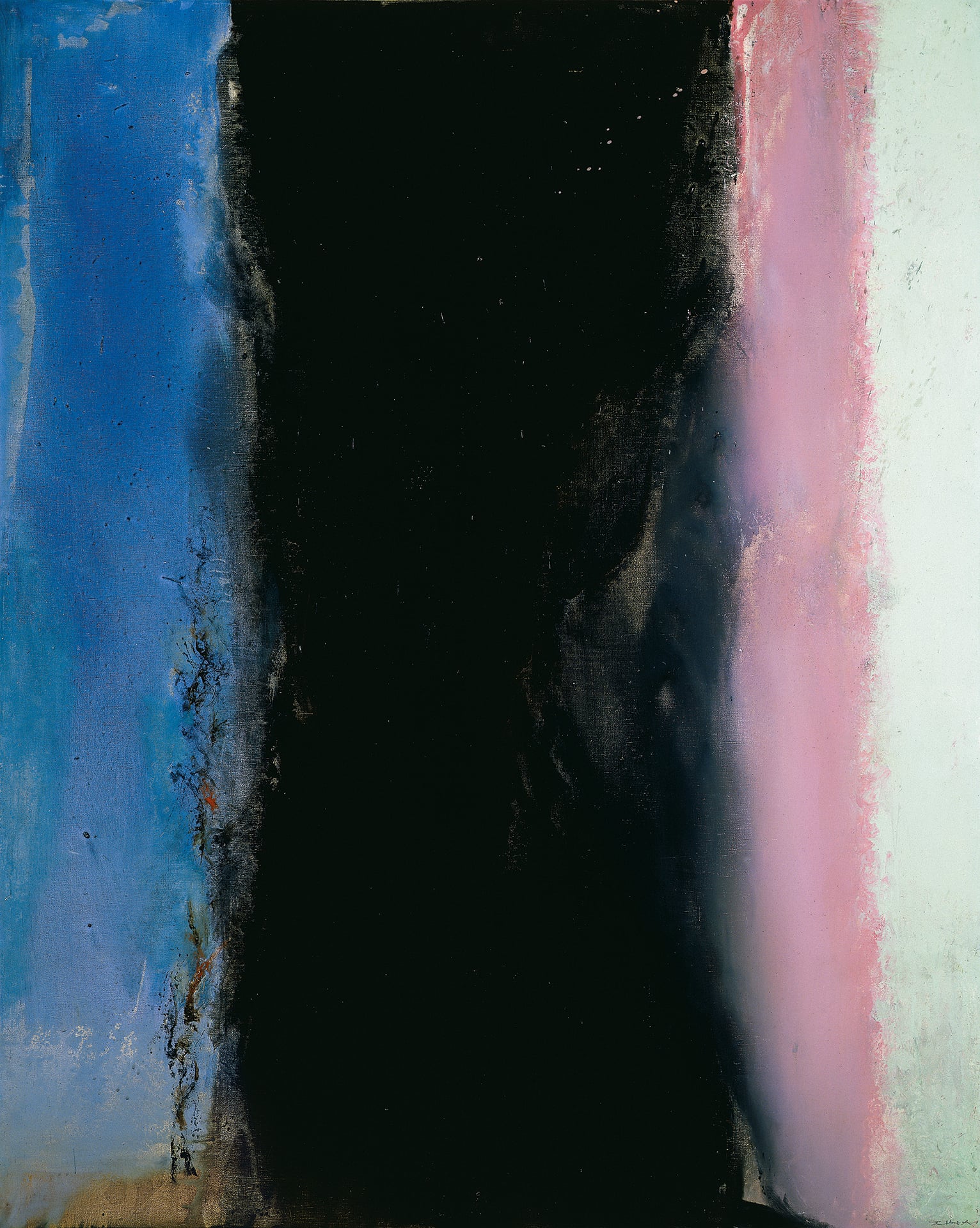
Hommage à Henri Matisse I - 02.02.86

1986

An open door into color

Hommage a Henri Matisse I by Zao Wou-Ki, a vertical painting with a deep black center, blue left edge, and pink-white right edge
Artwork image courtesy Fondation Zao Wou-Ki. Educational presentation.
Hommage à Henri Matisse I - 02.02.86100%
Hommage a Henri Matisse I by Zao Wou-Ki, a vertical painting with a deep black center, blue left edge, and pink-white right edge

Use the controls or mouse wheel to zoom. Drag the image when enlarged.

Enter the artwork study
09

Object in the Zao Wou-Ki study

Date
1986
Medium
Oil on canvas
Dimensions
162 x 130 cm
Collection / record
Musée d'Art Moderne de Paris
Catalogue / accession
Fondation Zao Wou-Ki works record

01 / Why this work matters

An open door into color

This tribute responds to Matisse's Porte-fenêtre à Collioure. A deep black center is held between blue, pink, and white vertical zones. The image is radically spare compared with Zao's turbulent paintings of the 1960s and 1970s.

The black field can be read as a doorway, a void, or pure pigment. Zao admired how Matisse made an apparently empty opening feel full of air, dust, and life. His homage turns that paradox into a concentrated meditation on presence and absence.
02 / Formal analysis

Five ways to read the visible evidence.

Move from color and composition toward the material surface and the space the work asks you to inhabit.
01

Color and light

The black center as both surface and depth

02

Composition and rhythm

Soft borders where neighboring colors breathe into it

03

Line and gesture

How restraint can create as much tension as gesture

04

Surface and material

The black field can be read as a doorway, a void, or pure pigment. Zao admired how Matisse made an apparently empty opening feel full of air, dust, and life. His homage turns that paradox into a concentrated meditation on presence and absence.
05

Space and scale

This tribute responds to Matisse's Porte-fenêtre à Collioure. A deep black center is held between blue, pink, and white vertical zones. The image is radically spare compared with Zao's turbulent paintings of the 1960s and 1970s.

03 / History and object record

Place the image inside a life, a period, and a documented record.

Historical interpretation

Zao Wou-Ki, 1986

The black field can be read as a doorway, a void, or pure pigment. Zao admired how Matisse made an apparently empty opening feel full of air, dust, and life. His homage turns that paradox into a concentrated meditation on presence and absence.

Landscape, calligraphy, memory, and postwar abstraction become an atmosphere the viewer can enter.

Exhibition and record history

What the cited record establishes

Recorded collection
Musée d'Art Moderne de Paris
Catalogue reference
Fondation Zao Wou-Ki works record
Exhibition chronology
The cited public record does not provide a complete exhibition chronology. Follow the primary record for provenance, display history, and future updates.

04 / Connections

Continue through neighboring works and parallel modernisms.

05 / Sources and further reading

Follow the object back to its institutional record.