Modern Chinese ArtistsObject Study 06

Pan Yuliang / 潘玉良

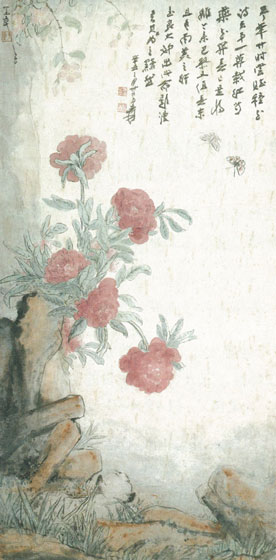
Peonies

by 1961

Flowers test whether fine-line can hold abundance without anatomy

Pan Yuliang's Peonies, an ink-and-color flower painting with an inscription
Image reference: Pan Yuliang research chronology, Li Ching Cultural and Educational Foundation. Educational presentation.
Peonies100%
Pan Yuliang's Peonies, an ink-and-color flower painting with an inscription

Use the controls or mouse wheel to zoom. Drag the image when enlarged.

Enter the artwork study
10

Object in the Pan Yuliang study

Date
by 1961
Medium
Ink and colour on paper
Dimensions
Dimensions not stated in the chronology
Collection / record
Documented in the Pan Yuliang research chronology
Catalogue / accession
Inscribed by Zhang Daqian in 1961

01 / Why this work matters

Flowers test whether fine-line can hold abundance without anatomy

Peonies moves Pan's linear and chromatic intelligence away from the human body. Petals gather in layered washes while stems and leaves give the composition direction. The subject connects her to a long Chinese flower-painting tradition, yet the color density reflects decades of oil and life study.

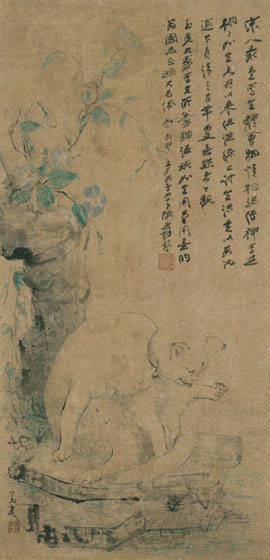
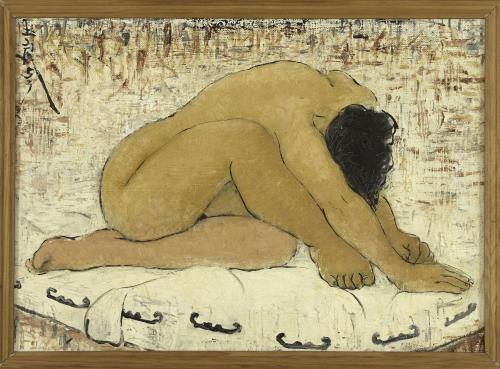
The work also challenges the assumption that Pan's importance rests only on the nude. Her practice ranged through portraiture, still life, animals, print, and sculpture. Peonies shows that the same questions of volume, permeability, and repeated line could animate a flower without turning it into a conventional symbol.
02 / Formal analysis

Five ways to read the visible evidence.

Move from color and composition toward the material surface and the space the work asks you to inhabit.
01

Color and light

Petal clusters built from overlapping translucent color

02

Composition and rhythm

Dark leaves giving the blossoms structural resistance

03

Line and gesture

Inscription and image balancing across the paper

04

Surface and material

The work also challenges the assumption that Pan's importance rests only on the nude. Her practice ranged through portraiture, still life, animals, print, and sculpture. Peonies shows that the same questions of volume, permeability, and repeated line could animate a flower without turning it into a conventional symbol.
05

Space and scale

Peonies moves Pan's linear and chromatic intelligence away from the human body. Petals gather in layered washes while stems and leaves give the composition direction. The subject connects her to a long Chinese flower-painting tradition, yet the color density reflects decades of oil and life study.

03 / History and object record

Place the image inside a life, a period, and a documented record.

Historical interpretation

Pan Yuliang, by 1961

The work also challenges the assumption that Pan's importance rests only on the nude. Her practice ranged through portraiture, still life, animals, print, and sculpture. Peonies shows that the same questions of volume, permeability, and repeated line could animate a flower without turning it into a conventional symbol.

The painter and sculptor who claimed the modern body, the self-portrait, and Chinese line as sites of authorship across Shanghai, Rome, and Paris.

Exhibition and record history

What the cited record establishes

Recorded collection
Documented in the Pan Yuliang research chronology
Catalogue reference
Inscribed by Zhang Daqian in 1961
Exhibition chronology
The cited public record does not provide a complete exhibition chronology. Follow the primary record for provenance, display history, and future updates.

04 / Connections

Continue through neighboring works and parallel modernisms.

05 / Sources and further reading

Follow the object back to its institutional record.